
New Work New Culture Reader
Prototype Edition
Table of Contents7 Preface
By Frank Joyce
9 Introduction: A Conversation about new work new culture What’s Wrong with “Old” Work? 19 The JOB System
20 Is Progress Good for Humanity?
By Jeremy Caradonna, The Atlantic
24 Four Calamities Destroying America’s Economy Being Ignored by Elites By Frithjof Bergmann, AlterNet
27 How Community Production Can Reduce the Cost of “Life Necessities” by Frithjof Bergmann
29 A Critique of Mass Manufacturing
by Frithjof Bergmann
32 Looking Deeper. Thinking Bigger.
by Frank Joyce, AlterNet
35 Is it Possible to Build An Economy Without Jobs?
by Frank Joyce, AlterNet
42 In the Name of Love
by Miya Tokumitsu
What is New Work?
48 After the Jobs Disappear
by Juliette Schor, NY Times
50 Detroit: BuildingCommunity and the New American Revolution by Peggy Kwisuk Hong
Food
57 How to Turn a Vacant Building into an Urban Farm
By Bryan Smith, Chicago Magazine
58 Feedom Freedom Blog, “Grow a garden, grow a community.” by Wayne and Myrtle Curtis
Finance
Manufacturing
63 Re-imagining Work: Another Production is Possible
by Rick Feldman
65 Brightmoor Youth Entrepreneurship Project, excerpt, SBS broadcasting
67 Model D, On the Ground: Youth Entrepreneurship in action by Matthew Lewis
69 New Work and Community Production: The Eyes of the World are on Detroit, by Barbara Stachowski
71 A Brave New ‘Work’ World
by Larry Gabriel, Metro Times
74 Create Anything Anywhere
by Blair Evans
75 Green City Diaries: Fab Lab and the Language of Nature
Model D and the Green Garage Urban Sustainability Library
Services
Energy
82 Community Electricity Lights up Spain
by Inés Benitez, IPS News
Art & Entertainment
87 Old World Meets New
by Linda M. Erbele
New Culture
The Environment
97 self evident truths in environmental justice
Emmanuel Pratt,
Governance
101 Detroit’s Grassroots Economies
by Jenny Lee and Paul Abowd
105 Cities In Revolt: Detroit
by Shea Howell
109 Beloved Community,
by Tawana Petty
110 New Work Field Street Collective’s New Paradigm
by Larry Gabriel, Metro Times
Education
115 New Work/New Culture education (From the ‘Inside-Out’)
by Bart Eddy
Conflict Resolution
120 Peace Zones for Life, Detroit Coalition Against Police Brutality
Ron Scott and Sandra Hines
123 Restoring the Neighbor Back to the ‘Hood’ Pledge
by Yusef Shakur
Art
126 Garage Cultural is expanding consciousness and horizons for kids in Southwest Detroit by Mike Ross, Metro Times
129 Heidelberg History, Heidelberg Project
www.heidelberg.org
Preface to the NWNC Reader, Prototype Edition
By Frank Joyce
What makes a society prosperous? Is the society/system in which some people have a lot of stuff automatically the best? Is poverty for billions a necessary and permanent condition of human life on earth? New Work New Culture challenges these assumptions.
Actually, New Work New Culture challenges everything. In offering a different way to organize work it opens the door to new thinking about education, government, art and entertainment and our relationship with nature. It seeks to reframe the conversation to reflect the growing inability of late stage race-based capitalism to meet the needs of people or the planet.
At this stage of its evolution, New Work New Culture does not pretend to have all the answers. Or even all the questions. That is why there are sections in this prototype New Work New Culture Reader that have no entries. Yet.
This book is a work in progress and probably always will be. We reject doctrine. We welcome in novation and creative thinking. We are committed to creating and sustaining a dialogue of theory and practice as we find our way.
We join the search for better ways of working and better ways of being because we believe that humans are learning that work impacts culture and culture impacts work. The dominant way of organizing how we work now serves to produce, reinforce and reproduce destructive ways of be ing with one another and with other species.
A few hundred years of thinking and being as required by the slave trade, industrialization, fac tory farming and endless war have taken a worldwide toll. Our collective mental health and our humanity is damaged and compromised.
That said, humans do not emerge from this era empty. We are full of hope, plans and ideas. You will see that in this book.
We invite you not just to read this prototype edition of the New Work New Culture Reader. Please help us in writing many new chapters for the next edition.
We express our gratitude to all of our contributors and especially to Mary Anne Barnett and Rick Feldman for their work in pulling this material together and to Roger Robinson and Ulysses Newkirk for their guidance and support in printing this prototype edition.
7
8
Introduction:
A conversation about New Work New Culture Grace Boggs, Frithjof Bergman, Kim Sherobbi, Barbara Stachowski, Rick Feldman and Frank Joyce.
In contemplating this book we held a conversation in early 2014 to think collectively about some of what we wanted it to cover. What transpired was a far ranging discussion that wound up focusing on the relationship between New Work and New Culture. Participants included Grace Boggs, Frithjof Bergman, Kim Sherobbi, Barbara Stachowski, Rick Feldman and Frank Joyce. Following is a lightly edited transcript:
Frank: Well we wanted to have a conversation that involved you and Frithjof especially to think about the introduction to the book and how we would frame what it is we’re trying to say. So my thought about a question to get us started is “What time is it on the clock of New Work?” Where does New Work fit in where we are now?
Grace: I think we’re at a watershed of civilization. I’ve been reading about the Neolithic period when people started farming and moved from hunting and gathering and began to live on the land. And I think that introduced a partnership relationship between men and women that most people don’t know about. Riane Eisler wrote about it in her book The Chalice and the Blade, and I think to introduce that concept of how living on the land creates a possibility of partnership relationships between men and women and that every transition to a new society as Sylvia Federici points out in her book Caliban and the Witch, offers that possibility. The witch hunts were an attempt to drive women from the land and men also into the cities to become proletarians. And I think to bring that into this New Work thing would be very important.
Frank: Frithjof do you want to respond to the same question or ask a new one?
Frithjof: I would like to respond to the same question. I very much agree with, underscore what Grace just said.
Grace: Well I think the idea new culture has to include a partnership relationship with men and women, and how living on the land restores that possibility.
Frithjof: Well very much so.
Grace: Because women’s ways of caring and thinking become so very important. Do you know the book by Riane Eisler, The Chalice and the Blade?
Frithjof: Yes, I do, I do I do I do. And Grace, forgive me, this is meant to be slightly humorous but I always like to emphasize I was a farmer three times in my life. So I have some idea what living on the land and actually making your living from the land is all about. Quite frankly because I’ve done it.
Frank: Would either of you want to say more about the idea of living on the land and relationships between men and women and the idea of community production?
Grace: I think the ecofeminist movement particularly has pointed out how women’s ways of 9
caring do not count the hours. They’re not like jobs, because there’s something emotionally satisfying about caring, about women’s work. And I think to bring in that aspect of women’s work, and how new work makes that possible would be very important.
Frank: I find that very helpful, because one of my things is to contrast the J-O-B system with New Work. In that context the J-O-B system is all about counting the hours and it’s all about keeping track and it’s all about fighting over the hours and who’s in charge of the counting and what is each hour worth.
Grace: Yes and the Job system is so dehumanizing that people compensate for it through higher wages and through greater production and that jeopardizes the earth.
Barb: You know when women do work, and some men too, you do what has to be done. You don’t check in, you don’t check out; you don’t clock in, you don’t clock out so I think that a difference in New Work and sort of the similarities between New Work and women’s work is that you do what has to be done. There’s no division of what kind of work– all the work is sort of what needs to be done.
Frank: Well an extension of that, of course or maybe it’s just a different way of saying the same thing, is that the J-O-B system controls how we spend our time, within a day and within a week and within a lifetime. The job of being a parent for example within the J-O-B system is to get the kid ready to get a J-O-B. So it controls how we think about parenting and how we thing about education and what it is children need to know. And then of course the children grow up thinking that the purpose of life is to have a J-O-B or to have a career, which is kind of the same thing.
Frithjof: This is not the same thing but it relates to what we’re talking about. I would like to emphasize in whatever we pull from here on in that community production is very like farming only on a different technological level. The overlap and the similarities between the life and the work of farming and the life and the work of community production, obviously but I think that can be pointed out and in some sense I always use the metaphor of a spiral. We are in some sense returning to what farming was like but on a higher level, on higher technological level.
Rick: I want to share a sense of what we’ve learned from other epochs: 1) It was not inevitable that capitalism emerged. People made choices, people lost battles; it was about power and that we’re at a similar moment where ideas matter and technology has provided us with the basis to both take the best from that epoch before capitalism did what it did, but also the best that capitalism did in terms of technology and production, whether it would have happened another way or not we don’t know, but technology provides the spaces for community production. So there’s a new synthesis between technology that emerged, or begins to emerge, I guess it’s always been there, but has clearly emerged an ability to decentralize but also in a global understanding. Because I think what we ought to show is that people can have a quality of life and we can create a quality of life that’s both local that’s also internationally understood and in relationship. We’re not talking about going backwards, we’re talking about going forward but taking those things that were destroyed for the last 4 or 5 hundred years and bring them forth: the women’s way of knowing, the relationship to the land and so
forth, so I appreciate what you’re all saying.
Frithjof: I understand very well what you Richard are saying. I’m asking but at the same time proposing that the make up for a spiral is useful. 10
Grace: Well I think the Agrarian phase of society was almost like a fall of community production. Because we think of the Agrarian mainly in terms of slavery because that was the way this country developed but when you live on the land, whole families live on the land; it’s a very different culture.
Frank: Well I have a question about that. If we go back to small family farms whether in England or Europe or the United States, two things occur to me. One is people made what they needed so if they needed a plow for example they figured out how to make a plow. They operated in communities, so if they needed to build a schoolhouse we all can think back to pictures of a barn raising for example. Mostly families gathered to do something that the community needed. It was small and it was local. Now I think we see as a result of fabrication technology and so on the chance to do that again in a localized comparable way. My question though is a question about technology. Fabrication is a high tech invention/evolution from manufacturing from computers from digital technology etc. etc. So fine, let’s say I can make a television set in a garage. But what if I need copper to make that television set and to run that fabricator but we have exhausted the world’s supply of copper? Then what happens?
Frithjof: That is your question? Can I say something before I answer your question? Namely, I would emphasize both. It’s a duality if you want. It’s dialectical in the sense that there are definitely are similarities to farming and of course we want to recover what has been buried
about farming and that is what we’re talking about. At the same time I would want to insist that there are differences. It’s not simply going back to farming. I think that would be a disastrous mistake to attempt that. So technology does make a very big influence and yes a quick way to put it is we don’t just make our own bread and our own salami and our own butter and our own eggs but to pick up on what Frank just said we are not that far from making our own television sets. We are very close to making our own electricity. I feel that has a sort of symbolic value that is high tech farming so to say. And I would not identify that only with fabricators; I think that’s a big mistake. In what I’m writing I’m trying to break down community production into 10 items or 10 categories. There are 10 things that meaningfully can be done with the existence of technology and each one of those 10 things can make us less dependent on money and less dependence on jobs. Now back to what Frank was saying. For quite some time frankly, I have been saying that no we will not run out of electricity, that’s ridiculous. In fact we are constantly inventing new ways of making electricity and there are now so many ways of making electricity that electricity, the scarcity of it, is almost no longer a problem. And I would say something like that about copper – that if we do run out of copper we’re very smart. We’ll find some other material that will do very well what copper did not as well. So we’ll improve the outcome.
Grace: I think it’s really important when we talk about additive manufacturing to realize that at one point we move from the Bronze Age, which was very rigid, to the Iron Age which was much more pliable so the additive manufacturing does not always have the same materials as previous, you can move, the materials used in the future will probably be not the same as, they will become paper but they will be different.
Frithjof: That’s part of what I’m saying.
Rich: I want to go back to Kim’s question. First, it is critical and that we’re doing the New Work reader in Detroit even though it’s a global conversation taking place. That has to do with the significance of community production in a city that has 50% unemployment among youth, and
11
that is a predominantly black city that emerges from the history of racism and capitalism. We believe through example and through theory that a new meaning of life can be given to that underclass, that outsider class that has historically evolved because of capitalist evolution over the last period. To struggle around community production is to negate seeing people as either parasites or predators but as contributing to humanity and to their community.
Grace: I think that what we need to show actually how the production takes place. To give some sense of you know, the same way in capital, you have the materials and you have the constant capital and the variable capital and we see changes taking place in the materials and all that. I think the introduction needs to give a sense what additive manufacturing really is like.
Kim: I can’t help but speak to the culture and Frank’s question about running out of copper or we run out of materials that were used previously. I understand that it’s definitely a possibility and it may happen that we’ll be using differently materials. But in the meantime as we’re looking for best practices and things of that nature we still have our past. And one of the things that’s happening right now in our present is we’re destroying the earth. So yesterday I was at an event at EMEAC and some people from Africa came. They’re doing a tour around the country and they’re saying “We’re being killed! And this has been happening for over 50 years and nobody said anything and its coming to a city near you! Our women are losing their babies. The oil has killed our crops. We are now starving.” And some of the spillage and some of the garbage and the toxins are now traveling across the world. We have to deal with that right now. So I’m saying that speaks to a culture. If we don’t get this culture together we’re not going to be here to do any of it. We’re not. The earth is going to be gone and we’ve got to look at how we’re treating people, how we’re interacting with each other. None of this will mean anything shortly. It will mean nothing. I mean we want to produce but if we don’t really look at the culture it’s going to even be hard to do anything with fabricators, with farming, with even doing things manually.
Rich: When you say culture what do you mean?
Kim: What I mean is how do we treat each other in terms of are we looking out for our brothers and sister, whether its locally, nationally or internationally. Are we really thinking about them? How do we shift to a more sharing type situation? How do we put in place systems and structures like mediation. We’ve been talking about that with the Peace Zones and what have you. But how do we put those things in place? How do we get our young people to focus in on values of compassion and being trustworthy and responsible and accountable? Not just our young people but all of us, but I think right now that’s one of the things that we should be doing is really focusing on our young people because we’ve missed the boat. To help them, to have compassion for other people. So I’m saying that we, there needs to be a strong emphasis on the more human things that Grace talk about.
Grace: I think the introduction has to have some real anthropology in it and to give some sense of how society has developed; how materials have happened.
Barbara: I’ve really been thinking a lot that the conference might be called New Culture New Work. I’m really feeling the whole women’s way of knowing and community and what I’ve just started thinking in the last couple days that we’ve talked about community production and I’m sure that a lot of people fabricators or 3D printers or a way of making a product or something
12
but it’s also community production, what comes first the chicken or the egg? Is what we need to produce, community? I think Kim and I are kind of on the same place. We need to develop a culture, a mindset; working on community production in the production sense will produce community maybe by proximity. I always go back to the Hmong. I spent the last five days at a
Hmong funeral and as soon as you walk into a space where there are a couple of Hmong people you enter in, it’s almost like I can let out a breath of air because I know somebody has my back. I don’t care what it is. People are paying attention to each other. You can’t even reach for a glass of water. I think part of community production is creating a culture of community. And I really think the women’s way of knowing as the Caliban and the Witch.
Grace: You know I almost feel this introduction is going to have to be like Capital. Rich: Three volumes? Do we get three volumes Grace?
Grace: Go from manufacturing to industrial production to New Work and to trace the development of work. Not only the variable capital but the constant capital of the materials, all that will have to be in there. It will be a quite a work of art.
Frank: By definition then it will be a work in progress. But I’m not just agreeing with you, I think that we do have to capture the long view for one thing. Because let me say a word about old culture, or the current culture and how oppressive it is and let me try to frame this as a question. In a way it’s almost a miracle that any kind of consciousness about New Work, New Culture, women’s way of knowing is entering the public conversation and the movie and your book that preceded it – it is hard to exaggerate how encouraging that is because of how stifling and oppressive and encompassing the culture of the J-O-B system is. What see on television, what we’re given is one false revolution after another. For example social media is revolutionary. No it’s not. We can all think of a lot of examples like that. But I also think we are at a point where there’s a disconnect between growing disenchantment with the J-O-B system and yet people not knowing how to connect to or make something better. Does anybody want to talk about that?
Kim: So the question is what is better? So now I’m thinking about what is better? We’ve been fed that better or good is having a lot of material things.
Frank: Yes, part of the J-O-B system, is that what is better is more. It’s entirely quantitative.
Kim: I wouldn’t even call it the J-O-B system as much as I would say you know, what America has framed and the American dream has been framed to be. The reason that people are in the J-O-B system is because they’re trying to get a certain lifestyle. We’ve all been brainwashed or fed this certain way of being. I’ve been challenging myself and others to think about what is better? In my community is better for us having more things? What has been better for us is having our children safe, having community. So many in my community, in the African American community have said, we didn’t even know we were poor. And now I ask the question, when did you find out? When did you decide you were poor? Who told you you were poor? And you know most of them said “when I went to college.” A lot of people come back and say, “When I went to college and I…” or “When I was exposed to this” because they didn’t have the things and that’s when they felt poor. Prior to that when they didn’t have money, when we didn’t have money none of us felt poor because we had a richer life. So I’m challenging and saying ok well let’s go back, let’s just think about what is better. Is it because of these material things, and I think we got to re-frame that. 13
Grace: I can remember when before people thought things mattered — what mattered was community. What mattered was not being an individual on your own. Rich: But people didn’t know, and this is a question, and I can imagine Jimmy having this conversation about when people, even when I was a kid, you went to the store on a regular basis. So you saw your neighbors. Then people got the larger supermarket and that even started with refrigeration. So when we look at this we have to be very historical to know that people did not know that they were going to consciously give up all those relationships as they became more and more independent. So I didn’t need my in-laws to babysit, I could pay a babysitter, right? I didn’t need to live near my family because I could drive to my family. And if you don’t do it historically it becomes nostalgia for the way life once was. And so the black community did what the American community did which was putting economic advancement, individual freedom above those relationships. And so we’re dealing with this thing now about freedom and choice that we have a necessity that it’s both out of necessity and choice we can create a new way of life. We’re not saying that people should be you know just scratching their fingernails to grow an apple and share an apple. We’re not saying that’s the way, but there is this whole thing between needs and wants and what are the cultural values that are more important. So Jimmy said that in the next American Revolution we will be giving up things, right? That’s a whole concept versus to get our humanity we have to give up things, right? That way people in Ghana or Bangladesh don’t have to be the garbage dump for our way of life.
Kim: So I’m glad you said it because I’ve been saying we have to go through it to understand it. Now that we know what comes out of being materialistic, let’s look at the best practices in our community, and lets create something else. So that’s the way I’ve been framing it to people. Now that we know we have to go through what we didn’t know, but now we know. I’ve also been saying as we talk to our children who are very angry, who are saying you all have not taken care of us. You’ve left us out here and we’re angry at you. So our conversation with them is we didn’t know. We thought too that it was going to be ok, but we can start from here. That’s where we should be in our conversation with our children also.
Frithjof: Can I say a couple of things? One thing is that on the issue of creating community I would want to emphasize that working together, that community production, that making things in the community, a community making things, is a way of creating community. And maybe it’s one of the most effective and powerful and feasible ways of creating community. I think working together does create community maybe more than all kinds of ethereal talk.
Frank: My second point is probably even more controversial and again I want to explicitly align myself with Kim here. Many times in my life I’ve said the best job I’ve ever had in my whole life was when I drove a fork lift in an auto factory many, many years ago. And I say that to say, yes workplaces create community. When I worked in a big factory, I very much was part of a community. We had a good time. And we socialized outside of the workplace. There was a connection there that was imposed on us because a factory is a system of enforced cooperation. It brings human beings together and it divides work in a certain way and it creates social as well as economic relationships. But I really think one of the things in this conversation that’s been most valuable to me and I think Barbara said it is – A part of creating community is the work of creating community. Of creating community for the sake of creating community, not treating it as it will be the byproduct of us doing something else. I think I’m understanding that this morning more clearly than I have understood it up to now. it. And I think that is what’s missing from,
14
Marx thought the mode of production alone would recapacitate people and it didn’t. It actually created more individuals.
Frithjof: Well I think the difference between what Marx was talking about and what we mean by community production is huge. I did visit any number of communist countries before I started working on New Work. And I started working on New Work after having spent time in communist countries because they struck me as inhuman. That there was very little compassion. There was no love of work and everyone seemed dreadfully depressed. So I have very little patience with Marx.
Frank: Well I don’t think it’s a question of being patient or impatient with Marx. I think this has been very rich conversation. One thing Frithjof I will say is I don’t have a lot of experience with this but I will say I think Cuba is a pretty good place and in my brief times that I’ve spent there I think there’s quite a bit of compassion and I think there’s quite a bit of satisfaction in Cuba.
Grace: Community cannot grow out of the mode of production. The mode of production is important. We now have a community mode of production but it has to be a psychological, philosophical process taking place alongside of it.
Frank: We have to grow our souls, to coin a phrase. I think we all agree on that. I mean the fact of the matter is that forget whether we like or don’t like Marx at the moment. By certain definitions, admittedly self-proclaimed definitions, I agree with all of those who say the world in the last 50 years has experienced an enormous amount of poverty reduction. But it has come at the expense of what we mean by community for one thing, and compassion and at the expense of the planet and of the resources of the planet. So this balance again between the consciousness of community, for lack of a better way to put it, and the stuff – the food, the objects, the material things that humans need to survive and thrive. If this introduction only makes one point my summation would be that the New Culture is as least as important if not more important than the New Work. Maybe we should seriously think about reversing the words we use here from New Work/New Culture to New Culture/New Work.
Grace: I think that I would recommend our rereading of Chapter 6, Dialectics and Revolution by Jimmy Boggs. He talks about how we’ve put so much effort and energy into production that we have forgotten what we have to do about ourselves.
Frank: OK. I think this is a good stopping point but if anybody wants a last word they should take it.
Grace: I think in the manifesto where Marx says the constant revolution in technology distinguished the bourgeoisie epoch and he ends it up by saying to face with sober senses our conditions of our life and our relations with our kind, we have to do that or face conditions of life but relationships with our kind. If we emphasize new work and not new culture we will be repeating mistakes of the 19th century, of Marx. By emphasizing production over culture.
Kim: When we say the word work first I think that people think about jobs. Work and jobs can be used simultaneously and I think some time people think about the work, I mean they switch the two. So I think if you say culture first it’ll help people understand that the culture has to change in order for the jobs to, the kind of new work that we’re looking for to take care of us to happen.
Rich: So my final comment is what new culture/new work/new work/new culture/mode of production/community production/community culture is all about is what we’ve historically 15
talked about as moving from dialectic materialism to dialectic materialism humanism. Where the role of consciousness and conscious choice and the values are as significant as what we have once called the material world. That there is a new unity being created at this moment in history because technology has advanced to the point where we can actually deal with that poverty in the deepest part of Africa that we’ve fucked for the last 500 years. But you can only do it if you deal with the sons of bitches that like to deal with luxury and greed, and be that 5%. So that’s my final comment. I think we’ll probably continue the rest of our lives with this conversation.
Frithjof: If somebody asks me Frithjof, what is it that you really address? What is the problem that you are really putting in the light? My answer is poverty… How much poverty has been reduced in the last few years? Don’t go by the propaganda that’s being told to you. If you look into India, if you look into Russia, if you look into Africa there’s plenty of poverty. So we do have a difference between us that to some extent is a personal difference. I live a different lifestyle from the life you live. I respect what you’re saying and what you’re doing supposedly. But I’m saying what I’m wanting to do frankly is different because to my mind, there are also people who don’t exactly hang onto my clothes but there are plenty of people who try to get some idea of where to go. So new work. My sense of it is that yes, production is crucial. I get this whole business of which comes first, the chicken or the egg, I find really I don’t know. Should it be first production or first the souls or first the souls or first production? To my mind I find it extremely interconnected and interlinked. I do feel that’s my last sentence. Whatever experience I have had that talking to very very poor people about changing their souls is really creating a situation where they put on their jackets and leave.
Grace: I think the mission of the human is to become fully human. And we need modes of production that make that possible. And now we have modes of production, jobs that make that impossible.
Kim: When I talk about education now, I ask people what kind of education are you talking about, and who’s your audience? So I’ll say, because we use education so general. So I’ll say are you talking about an education about being a parent, are you talking about a street education, are you talking about a formal education? Because we use it so broadly. We paint with this broad brush so when I’m talking to a person they might say, oh well that doesn’t fit me. So I’m glad you said what you said because what I’m talking about when I’m talking about growing our souls, I’m not talking about poor people in countries who have never had any money. I’m talking about those of us who’ve had resources who have not considered others or maybe who actually need to change so we can help the people who haven’t had any resources at all. This is not a one-size-fits-all. So I know what you’re talking about when you talk about people who have never had economic security at all. I’ve had conversations with people who’ve told me, I’ve never had it and I want it! And you’re not going to take it away from me. You’re not going to take that opportunity away from me, you’ve had it before Kim and I want that. So to have conversations with folks and explain to them that I have their best interests at heart and I can just share what my experience has been having some of those things. It’s a challenge to do that but for the record I’m not talking about everybody, only if it fits.
Rich: Thank you. Party’s over! We love you Frithjof, thanks! Long live mode of production, the end of poverty and the revolution to grow our souls! Long live dialectics!
Frithjof: We need more conversations like this.
16
What’s Wrong With
“Old” Work?
The JOB System
The J-O-B system organizes the work of the world in a certain way.
• It offers too much to some and little or none to others.
• It depends on production for the sake of production and consumption for the sake of consumption.
• It compels unequal relationships between employers and the employed. • It is cruel to the unemployed.
• It drives the insatiable destruction of precious natural resources. • It is hostile to the creation of community.
• It is inherently stressful to individuals, families and society. It deforms the entire process of education.
• It politically empowers some to the unnecessary disadvantage of others. • It reproduces entrenched racial and global disparities.
• It promotes conflict rather than cooperation.
• It reqires dishonesty and deceit at every turn, espcially in the marketing of everything
• As currently structured, the global J-O-B system is not only failing – it is a menace to life on the planet. It is a system whose time is past.
19
Is Progress Good for Humanity?
By Jeremy Caradonna
The Atlantic Magazine
The stock narrative of the Industrial Revolution is one of moral and economic progress. Indeed, economic progress is cast as moral progress. The story tends to go something like this: Inventors, economists, and statesmen in Western Europe dreamed up a new industrialized world. Fueled by the optimism and scientific know-how of theEnlightenment, a series of heroic men—James Watt, Adam Smith, William Huskisson, and so on—fought back against the stultifying effects of regulated economies, irrational laws and customs, and a traditionalguild structure that quashed innovation. By the mid-19th century, they had managed to implement alaissez-faire (“free”) economy that ran on new machines and was centered around modern factories and an urban working class. It was a long and difficult process, but this revolution eventually broughtEuropeans to a new plateau of civilization. In the end, Europeans lived in a new world based on wage labor, easy mobility, and the consumption of sparkling products.
Europe had rescued itself from the pre-industrial misery that had hampered humankind since the dawn of time. Cheap and abundant fossil fuel powered the trains and other steam engines that drove humankind into this brave new future. Later, around the time that Europeans decided that colonial slavery wasn’t such a good idea, they exported this revolution to other parts of the world, so that everyone could participate in freedom and industrialized modernity. They did this, in part, by “opening up markets” in primitive agrarian societies. The net result has been increased human happiness, wealth, and productivity—the attainment of our true potential as a species.
Sadly, this saccharine story still sweetens our societal self-image. Indeed, it is deeply ingrained in the collective identity of the industrialized world. The narrative has gotten more complex but remains à la base a triumphalist story. Consider, for instance, the closing lines of Joel Mokyr’s 2009 The Enlightened Economy: An Economic History of Britain, 1700–1850: “Material life in Britain and in the industrialized world that followed it is far better today than could have been imagined by the most wildeyed optimistic 18th-century philosophe—and whereas this outcome may have been an unforeseen consequence, most economists, at least, would regard it as an undivided blessing.”
The idea that the Industrial Revolution has made us not only more technologically advanced and materially furnished but also better for it is a powerful narrative and one that’s hard to shake. It makes it difficult to dissent from the idea that new technologies, economic growth, and a consumer society are absolutely necessary. To criticize industrial modernity is somehow to criticize the moral advancement of humankind, since a central theme in this narrative is the idea that industrialization revolutionized our humanity, too. Those who criticize industrial society are often met with defensive snarkiness: “So you’d like us to go back to living in caves, would ya?” or “you can’t stop progress!”
Narratives are inevitably moralistic; they are never created spontaneously from “the facts” but are rather stories imposed upon a range of phenomena that always include implicit ideas about what’s right and what’s wrong. The proponents of the Industrial Revolution inherited from 20
the philosophers of the Enlightenment the narrative of human (read: European) progress over time but placed technological advancement and economic liberalization at the center of their conception of progress. This narrative remains today an ingrained operating principle that propels us in a seemingly unstoppable way toward more growth and more technology, because the assumption is that these things are ultimately beneficial for humanity.
Advocates of sustainability are not opposed to industrialization per se, and don’t seek a return to the Stone Age. But what they do oppose is the dubious narrative of progress caricatured above. Along with Jean-Jacques Rousseau, they acknowledge the objective advancement of technology,
but they don’t necessarily think that it has made us more virtuous, and they don’t assume that the key values of the Industrial Revolution are beyond reproach: social inequality for the sake of private wealth; economic growth at the expense of everything, including the integrity of the environment; and the assumption that mechanized newness is always a positive thing. Above all, sustainability-minded thinkers question whether the Industrial Revolution has jeopardized humankind’s ability to live happily and sustainably upon the Earth. Have the fossil-fueled good times put future generations at risk of returning to the same misery that industrialists were in such a rush to leave behind?
But what if we rethink the narrative of progress? What if we believe that the inventions in and after the Industrial Revolution have made some things better and some things worse? What if we adopt a more critical and skeptical attitude toward the values we’ve inherited from the past? Moreover, what if we write environmental factors back in to the story of progress? Suddenly, things begin to seem less rosy. Indeed, in many ways, the ecological crisis of the present day has roots in the Industrial Revolution. For instance, consider the growth of greenhouse gases (GHGs) in the atmosphere since 1750. Every respectable body that studies climate science, including NASA, the National Atmospheric and Oceanic Administration, and the US Environmental Protection Agency (EPA), has been able to correlate GHG concentrations with the pollutants that machines have
been spewing into
the atmosphere since
the late- 18th century.
These scientific bodies
also correlate GHGs
with other human
activities, such as the
clearing of forests
(which releases a lot
of carbon dioxide
and removes a crucial
carbon sink from the
planet), and the
breeding of methanefarting
cows. But fossil
fuels are the main
culprit (coal, gas, and oil) and account for much of the increase in
Carbon dioxide (PPM), methane (PPB), and nitrous oxide (PPM) in the atmosphere since 1750. Before the Industrial Revolution, CO2 levels had long been stable at about 280 PPM. Now they’re above 400 PPM. CO2 levels have not been this high for at least 2 million years. (USGCRP 2009)
21
the parts per million of carbon dioxide in the atmosphere.
The main GHGs, to be sure, are carbon dioxide (CO2), methane (CH4), nitrous oxide (N2O), and a few others, many of which can be charted over time by analyzing the chemistry of long-frozen ice cores. More recent GHG levels are identified from direct atmospheric measurements.
What we learn from these scientific analyses is that the Industrial Revolution ushered in a veritable Age of Pollution, which has resulted in filthy cities, toxic industrial sites (and human bodies), contaminated soils, polluted and acidified oceans, and a “blanket” of air pollution that traps heat in the Earth’s atmosphere, which then destabilizes climate systems and ultimately heats the overall surface temperature of the planet. The EPA is quite blunt about it: “Increases in concentrations of these
gases since 1750 are
due to human activities
in the industrial era.”
It’s worth noting, too,
that the population of
the world only began
to take off during the
Industrial Revolution. For
millennia, the population
of homo sapiens was
well below the 1 billion
mark, until that number
was surpassed around
1800. The world now
has 7 billion people and
counting. That’s a lot of
Carbon dioxide and methane levels in the atmosphere since 1750. (NASA, based on data
from the NOAA Paleoclimatology and Earth System Research Laboratory)
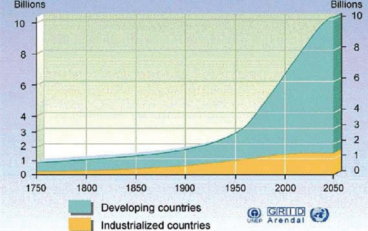
Population levels in developing and industrialized countries over time, with future projec
tions. (Philippe Rekacewicz, UNEP/GRIDArendal)
22
people who require food, energy, and housing and who place great strains upon global ecosystems. Consider the following figures:
When we take these trajectories into
consideration, the
Industrial Revolution starts to look like
something less than an “undivided blessing.” It begins to look like, at best, a mixed blessing— one that resulted in technologies that
have allowed many people to live longer, safer lives, but that
has, simultaneously, destroyed global ecosystems, caused the extinction of many living species, facilitated rampant population growth, and wreaked havoc on climate systems, the effects of which will be an increase in droughts, floods, storms, and erratic weather patterns that threaten most global societies. All of this is to say that the simple-minded narrative of progress needs to be rethought. This is not a new idea: In fact, critics of industrialization lived throughout the Industrial Revolution, even if their message was often drowned out by the clanking sounds of primitive engines. In their own particular ways, thinkers and activists as diverse as Thomas Malthus, Friedrich Engels, the Luddites, John Stuart Mill, Henry David Thoreau, William Wordsworth, and John Muir criticized some or all aspects of the Industrial Revolution. The narrative of industrial-growth-as progress that became the story of the period occurred despite their varied protestations. The Luddites questioned the necessity of machines that put so many people out of work. Engels questioned the horrendous living and working conditions experienced by the working classes and drew links between economic changes, social inequality, and environmental destruction. Thoreau questioned the need for modern luxuries. Mill questioned the logic of an economic system that spurred endless growth. Muir revalorized the natural world, which had been seen as little more than a hindrance to wealth creation and the spread of European settler societies around the globe.
These figures have provided wisdom and intellectual inspiration to the sustainability movement. John Stuart Mill and John Muir, for instance, have each been “rediscovered” in recent decades, respectively, by ecological economists and environmentalists in search of a historical lineage. For the sustainabilityminded thinkers of the present day, it was these figures, and others like them, who were the true visionaries of the age.
This post has been adapted from Jeremy Caradonna’s new book, Sustainability: A History.
This article available online at:
http://www.theatlantic.com/business/archive/2014/09/is-progress-good-for-humanity/379781/
Copyright © 2014 by The Atlantic Monthly Group. All Rights Reserved.
23
4 Calamities Destroying America’s
Economy Being Ignored by Elites
AlterNet [1] / By Frithjof Bergmann [2]
Published on Alternet (http://www.alternet.org)
The world’s current economic and political structures are proving incapable of fixing the global crisis of poverty, unemployment, and dislocation from a viable way of life for the majority of the world’s population. Why? Let us begin with one present-day example: Larry Summers, former Secretary of the Treasury and also former chair of the Board of Economic Advisors, recently was the principal guest of the national radio broadcast “On Point.” The topic of the hour-long dia logue was growing “inequality.”
Summers posited that we are in an oddly slow recovery. He gave some reasons for the slowness but maintained that the measures instigated by the government (the Federal Reserve pumping funds into the economy, and the like) were fundamentally correct, and that with patience and persistence the recovery would solve the problems we have.
This basically is the position of Obama and importantly, by no means only his. Every government in every country subscribes essentially to this same apostolic faith. That faith is pathetic and even grotesquely mistaken. It ignores the four “Tsunami” causes for the globally increasing inequality:
1. Automation: The number of jobs that have been automated out of existence in the last 30 years is astronomical. Any effort to enumerate them would be silly. Useful, on the contrary, are perhaps a few hints of the kinds of automation that are still in the future, but nonetheless just around the corner. Observe what is happening in retail – Amazon.com [3], and more generally in the service sector, in banks and offices; but beyond that consider the near future of robotics, and close to that the potential of self-driving cars, and of course the galloping field of fabricators. Automation so far has only been the first breeze of an approaching hurricane.
2. A second colossal cause is globalization. Despite the nonstop discussion of that topic its basic significance is still largely misunderstood. That factory work is outsourced to lower wage coun tries is a belittling phrase; more accurate is the contrast between the former monopoly of a very few colonial powers and the now prevailing condition where all countries everywhere — even the Central African Republic and Borneo and Mongolia — are in development. In other words, in all countries people are looking for jobs. Thus the supply of labor has burst through all bounds! This in turn means that the value of unskilled work has plummeted beyond human sustainability much less economic growth.
3. Environmental degradation is growing. The depletion of natural resources is directly caused by fruitless efforts to stem unemployment. Unemployment threatens to grow continuously and the only response we have so far marshaled is economic growth, which self-evidently is coupled to the depletion of our resources.
4. The fourth mega-force that escalates inequality everywhere is the industrialization of farming. Throughout the millennia of the Agricultural epoch approximately 75% of the population lived and worked on farms. That percentage only started to gallop away from this ratio when farming 24
became mechanized. However, in the brief period of less than 200 years a breathtaking transfor mation has taken place. Worldwide 70% of farmers have been driven from their work and their land. In country after country the percentage of people still working and living on farms has thundered downwards so that it is now in some countries only about 4%. On some continents that human migration is still in its headlong tilt: but as villages die, the former farmers do not find work; they are absorbed in slums and sink down in the morass of extreme poverty, violence, crime, prostitution and drugs.
The really foul and grotesque dimension of this lies in its cognitive segregation, for the world wide migration away from the farms is hardly mentioned when the deficit of jobs and the rise of inequality are discussed. In sheer numbers, this is obviously the most gargantuan cause.
It is stunning that there are whole shelves of books about the job-problem, but the reality of the loss of working on farms has rarely been included in the workforce calculations. In essence it means that 75% of the total working population have been cut off from their work and that the need to find re-employment for that huge number is part of the monster-problem that we are failing to even identify let alone solve.
If one adds these four Tsunamis together —automation, globalization, destruction of natural resources and the industrialization of farming — then it becomes obvious that the remedies now applied — stimulation of the economy, raising the minimum wage, more education and the rest — are laughably inadequate. It also becomes evident that we are emphatically not in a recovery, somnambulant or otherwise.
None of these causes are “circular,” or as it is sometimes expressed cyclical, which recoveries by definition are. All four are linear: automation, globalization, destruction of the environment and the migration away from the land will grow, far beyond where they are now, and will multiply. The inequality will become even more monstrous and more dangerous than it is now. The con trast between slums and the palaces of the superrich is already surreal and fantastic, but it will grow further and beyond our worst imaginings. The faith that we are in a circular turning wheel situation, and that automatically, obedient to the laws of economics, we move towards equilib rium, is totally unfounded. It is just a misguided medieval superstition.
We are not turning in a circle; on the contrary we are undergoing a gigantic linear transformation that is as all changing as the shift from agriculture to industrialization.
Why is this a gigantic linear transformation? Because there is no circling back to a former “bet ter” time. The mega-factors listed have produced an enormous rift or a bifurcation. It is a split between the 20%, Oasis people (the rich) and the 80%, Desert people (the poor.) Other groups have of course a greater liking for describing the division as between 1% and 99% but that seems too exaggerated.
New Work New Culture is a new way of looking at and actualizing how people can live in peace and prosperity, working together to provide what is needed not just for survival but for joyous fulfillment. People of good will must stop looking back, yearning for the good old days.
New Work New Culture gives us a roadmap to take on the task to articulate a ladder that defines 25
a practical, performable sequence of steps in detail that is realistic and manageable. By doing so we will not just alleviate the four Tsunami Calamities but give life to a rise, an ascent that has become possible with the technology that we now have.
(Frithjof Bergmann is a retired Professor of Philosophy from the University of Michigan. He has been writing, teaching and organizing for the ideas of New Work for more than 3 decades. He has authored many works, including On Being Free (1977). He is a principal organizer of the New Work New Culture conference [4] in Detroit, Michigan from October 18-20.#NWNC2014 [4]) [5]
Source URL: http://www.alternet.org/4-calamities-destroying-americas-economy-being-ignored-elites Links: [1] http://alternet.org [2] http://www.alternet.org/authors/frithjof-bergmann [3] http://amazon.com/ [4] http://reimagin ingwork.org/ [5] mailto:corrections@alternet.org?Subject=Typo on 4 Calamities Destroying America's Economy Being Ignored by Elites [6] http://www.alternet.org/tags/economy-0 [7] http://www.alternet.org/%2Bnew_src%2B
26
COMMUNITY PRODUCTION: HOW COMMUNITY PRODUCTION CAN REDUCE THE COST OF “LIFE NECESSITIES”
By Frithjof Bergmann
1. FOOD
2. HABITAT/RENT
3. UTILITIES
4. TRANSPORTATION
5. CLOTHES AND SHOES
6. FURNITURE
7. INSURANCE
8. MEDICAL EXPENSES
9. EDUCATION
10.CHILDCARE
Through a great deal of observation, experimentation and testing we eventually arrived at this list of 10 “Life Necessities.” Nothing was ironclad nor universally hard and fast. Individuations and exceptions appeared at every turn. Nonetheless, slowly, a fairly consistent pattern emerged. Regardless even of the continent on which we were examining the lives of people in extreme poverty, despite the multispangled variety, as it were, throughout it, poverty to our surprise seemed relatively coherent and similar everywhere.
Everything depends of course on what one means by this. A first glimmer of specificity enters the picture the minute we say that food is of course the first and most demanding of these “Life-Necessities.” Not surprisingly, some high beam thoughts that connect food with the New Work framework arise at once. How possible is it to reduce or terminate the buying of food and substitute it with growing one’s own. It is interesting, I think, that the hard as nails resistance to this, on its face, so obvious a proposal is a cultural objection. The people that we call “Desert People” do not want to “go back” to the growing of their own food. That was the plight of their ancestors, and returning to it spells defeat and capitulation instead of the positive connotations that well-meaning development workers intend.
Dealing with this is naturally only a first basic step. The reference to or the introduction of advanced hitherto unknown technologies helps to undercut any notion of a “going back” and in that way proves decisively helpful in this as in hosts of other contexts.
In the case of Urban Gardening what is needed for the all-important transition of genuine “Desert People” from the economy of buying to the economy of self-making is that the technologies used for self-making must be fairly advanced and should if possible not resemble too closely 27
the technologies that these people may have used before. That thought is of course shocking to some, especially if one is used to the context of middle class people who add to their luxury and to the burnishing of their self-image the vegetables they have grown on their balcony. Among the examples that illustrate vividly this break from the past in our manifold experience are the “vertical containers” that are by now one of the emblems of New Work. To call them an advanced technology would of course be comical, but that misses the point. They constitute a obvious difference from the gardening of the past and that is what counts. Parallel thoughts apply to greenhouses and most especially to the raising of algae where New Work has emphasized that it is possible to make from algae virtually everything, such as plastics and nylons, for which now we rely on oil.
For the cardinally important transition from the economy of buying to the economy of selfmaking, for that to begin even in baby-steps our list of the ten “life-necessities” is of considerable value. The point has some resemblance to our point about technology. To stress that ten “lifenecessities” constitute a unit that is in a serious sense “complete” has great impact on Desert People. It means that these ten are all that you firmly need, but still more importantly that all you need can be partly made by yourself and need not be purchased, at least not completely. That makes the idea of an alternative economy of selfmaking far more graspable and realistic than it was before. Instead of floundering in a slippery fish-tank of possibilities we can now nail to the wall exactly what we mean: attain a condition
where these ten are self-produced and not entirely purchased and a new and different economy has been reached.
No matter how shabby and dilapidated their habitat is, for virtually all Desert People it commonly is their greatest monthly expense. Therefore the chain that ties them most tightly to the incomemaking life is the “rent” (even if they own their habitat there are costs) they must pay. How very much slum-dwellers often know about the absurdities of normal building is by itself enough to raise one’s estimate of their intelligence. That is one of the many reasons for New Work’s long and determined interest in unconventional, not well-known ways of building, and there again the fascination with previously not encountered technologies asserts itself.
28
A CRITIQUE OF MASS MANUFACTURING as a first step towards New Manufacturing
By Frithjof Bergmann
Few of our convictions are any firmer than our belief that mass manufacturing cannot be surpassed. We have seen countless video clips of cigarettes gushing in something resembling a waterfall from the end of a line, or coke-bottles moving like toy-trains rapidly around curves between small wire fences. So we are dead sure that nothing could be cheaper, or more efficient and modern than that way of manufacturing the products we like. It hits us therefore as an almost shocking surprise that this is not necessarily so.
There is an alternative that is cheaper, more efficient and above all more modern – and vastly more ecologically conserving of nature.
The decisive argument for all this is almost insultingly simple: In a banal way it just highlights the additional costs that on second thought are not external at all.
First and most blatant among these are of course the costs for transportation. If the manufacturing is centralized it occurs in one limited place and then inevitably built into this system the products must be dispersed, and the more extreme the centralization and the wider the distribution the more complex and the more costly the transportation will become. But the sheer movement from the place of production to the place of consumption is just the beginning. The minute that part is recognized and acknowledged the clamor from all the other surrounding costs rises higher and higher. This is a situation where opening the door to the one most insistent and closest factor means that a quickly growing crowd elbow themselves into ever more prominent view. After the variety of modes of transportation, and some might be by truck, others by rail, and still others by boat, there appear inescapably the host of additional arrangements that need to be put into place close to the point of use or consumption. These include the acts of unloading but beginning from those snakes an interminable chain of further provisions from renting the space, and training and paying the salespeople to the great number of precautions and safety assurances that must be arranged, to the lighting that needs to be paid for and not least the food. All of these and still many more, numbers that it would be too tedious to list, are all enmeshed in the far flung network which centralized mass-production requires in order to function.
Now imagine the contrast as decisive and sharp as it can be conjured up, imagine a mode of production that has dispensed with the whole of this clutter, that has thrown the totality of these auxiliaries overboard; a way of producing where one machine, but one of so far utterly unimagined flexibility and capacities for modulation and adjustment, stands as alone as a flagpole and makes a seemingly endless and unlimited variety of products so that the people near it can amble up to it, casually one by one and first describe what they want and then, only a little while later pick it up the new product and start immediately to put it to use. Juxtapose these two ways of making and you have the first glimmer of an idea, of course so far caricatured, simplified, and exaggerated of what New Manufacturing as the next way of producing things will be magnificently superior to mass manufacturing.
29
There is a second very different, sweeping development that also played a large role in shaping the gradual growth of what we more and more call New Manufacturing, the other forward motion is “miniaturization.” The single most graphic and to us most palpable instance of what is happening in the world of the smaller and smaller is the “I –phone” in our pockets, to which week by week if not daily new functions and apps are added into their miniature space. As most of us know, that same shrinking has also occurred with computers, where computers not that long ago filled the space of a room while they now fit snugly into our pockets and beyond that are no larger than a button or even the head of a pin.
The contours of the changes in this direction, not towards the more gigantic and centralized but towards the opposite, the smaller and more dispersed extend of course very much further. It rather recently has taken by storm large parts of the domain of education. The number of the top universities that offer their best courses more or less for free over the Internet is growing by leaps and bounds. This means that one solitary person anywhere, in a valley or on a mountain top, can study everything that has ever been written or choreographed or composed. No need for libraries, or professors, or infrastructure of any kind. I hope you notice the striking similarity to the “exaggerated” “caricatured” picture of a possible future mode of manufacturing I described before.
We do realize that we are technologically many miles from achieving in manufacturing the equivalent to the reality that we already have attained in the kingdom of information: something like full-fledged small factories in individual houses, so widely dispersed that manufacturing could take place virtually anywhere with only the most minimal infrastructure, and in a fashion that would be as autonomous as not long ago was farming.
To articulate this more fully: The New Work Communities’ panoramic picture of where the world now is stresses (as we have said before) four overpowering tsunami-like threats that mountainously roll in from the ocean and descend towards us. The spell-binding contrast is the paralyzing collision between these four mortal dangers and our impotent and witless helplessness in the face of them. We stare at them like a deer blinded at an onrushing car. It is precisely this blindness and this helplessness that in the eyes of New Work is its great challenge and task. This has been our conviction for a very long time, in truth not just for years but for decades. In this long time we have scanned the horizon but also left no stone unturned to find serious, workable, realistic ways in which the four tsunami threats could be not just slowed down, but halted and indeed reversed.
Of course we are eagerly ready to admit that our New Work proposals are often extraordinarily futuristic (which does not mean utopian but just years from where we are now) but that they put forward this one now discussed claim: that just possibly they are the only game in town, that nothing else at all on the table comes even close to having the power. The power to just close the split between the Desert and the Oasis people, let alone avert the other threats, the changing of our climate, the exhaustion of our resources, and the burning out of our culture.
If we now return to the rapidly increasing monster inequality from which we started then we have to admit that the means which we currently employ to heal that bifurcation are lamentably inadequate. We encourage growth, quicker upwards spiraling to still greater productivity, to the making of still more goods. But the fact is that in spite of the occasional talk about the millions in China that have been moved out of poverty, the picture taken as a whole, if one does not allow
30
oneself to be distracted by a bright spot here or there, but insists on assembling out of all the pieces a coherent whole, is dismal. We maintain that the overall picture speaks in any case in glaring colors, and this comprehensive picture leaves no doubt that an approach wholly different from those so far applied is needed with alarm-ringing urgency.
The need for a different approach to production is as plain as the difference between large and small. Mass Manufacturing has become ever more centralized and in line with this ever larger and more massive. The leading conception as an antidote to this is in the context of New Work’s community production and its smallness and associated benefits.
31
Looking Deeper. Thinking Bigger.
By Frank Joyce
Published on Alternet (http://www.alternet.org)
(Note: This article is adapted from “We Are in the Middle of Transformational Change: It’s Time the Debate Matches up with the Huge Challenges Ahead of Us,” published at AltNet.org. in January of 2010.)
A better world is possible. So is a worse one. Which will we get? Finding the proper focus is itself a challenge.
For example, much of the conversation these days is about what the President (or somebody) ought to do about jobs. But isn’t that the wrong conversation altogether?
As it always has been and always will be, there is plenty of Work that needs doing – growing food, moving people and goods around, teaching young people, manufacturing various kinds of stuff, curing sick people and so on. But the 20th century “jobs” method of connecting those needs to individuals, families and communities has been seriously out of whack for quite some time.
What was once mostly a W-2 economy is now a mashed up “system” of W-2, 1099, underground and prison-industrial “employment.” It produces and requires an exorbitant rate of incarceration, massive school dropout numbers, high crime rates and perpetually high unemployment. Further evidence of systemic breakdown is revealed by recent “revelations” that more education does not truly bestow immunity to income stagnation and recurring unemployment. Like it or not, absent a radically different approach, job elimination will continue to outpace the trend toward job creation in good times and bad.
Truth be told, just about all of the systems that sort-of, kind-of solved various problems for the last 200-300 years don’t work all that well anymore. They are out of alignment with current reality.
• Economic globalization under the domination of supranational corporations which incorporates and drives massive changes in science and technology and in the role of nation-states. • Climate change.
• The collapse of the cold war nuclear balance of power. The possible use of nuclear weap ons by countries that possess them, most notably the United States, remains a threat. But now, so does the possibility of their use by nonstate actors like AI Qaeda.
• Changes in the species homo sapiens: human reproduction no longer requires intercourse; neuroscience and pharmacology are increasingly used to modify human behavior, longevity has increased dramatically; our diet is very different; the status of women is drastically altered.
These forces are rocking our planet as it has never been rocked before. All are fast moving. Each is significant.And each one powerfully impacts the others. By way of illustration, consider the nature and role of nation states. “Old” nations such as China are profoundly different than they were less than 50 years ago–never mind 300 or 1200 years ago. The same is true of “middle-aged” nations such as the United States. (The United Nations had 51 members when it was founded in 1945. Today it has 192. Thirty-three nations have come into existence just 32
since 1990. It’s that dynamic that makes even a relatively new kid on the block such as the US middle aged.) But be they ancient or newborns, aIl nations today are struggling to define their relationship to global corporations loyal to no nation-state whatsoever. For the time being, governments are not effectively regulating the behavior and setting the rules of the road for corporations. The BP oil blowout is but one dramatic example.
Yes, the American Revolution created an effective alternative to the tyranny of the British throne. But more than 200 years later our system of government is conspicuously not up to the test of offsetting the tyranny of Big Finance, Big Energy, and Big Health Care.
Naturally, such dramatic change creates noise and confusion. How could it be otherwise? Much of the twentieth-century world order was explained and even predicted by Adam Smith, John Maynard Keynes, Karl Marx, Sigmund Freud, CLR James, Albert Einstein, Franz Fanon, and others. But that has yet to happen for the emerging world order of the 21st century.
There are some exceptions, but mostly what we have instead are “cutting the foot to fit the shoe” efforts by neo cons, neo liberals and neo Marxists alike. None of their theories entirely anticipate or fullycontend with the forces of massive change underway.
So, in the U.S.we hear calls from aI/ points of the ideological spectrum to take America back, recapture the American dream, restore America’s place in the world, “save” this and “defend” that. Elsewhere AI Qaeda, the Taliban and other organizations are also dedicated to restoring a long-gone-and-never-to-return economic, political and social order.
But can the new reality be crammed back into the old assumptions and structures? Is “left to right” the immutable and permanent way of defining the political positions that humans can adopt? Yes,the left-right spectrum retains some descriptive power. But as a genuinely useful tool of analysis, let alone the source for envisioning better ways to organize human activity-not so much.
That is not to say that efforts to start from today’s reality are not underway. Bruce Lipton and Steve Bhaerman in their book, Spontaneous Evolution: Our Positive Future and How to get There from Here; Grace Boggs drawing on the foundation laid with the late James Boggs; Naomi Klein, Jeremy Rifkin in his new book The Empathetic Civilization:The Race to Global Consciousness in World Crisis; the editors and writers at Monthly Review and many others are working to understand, describe and define the forces in play. It is not an easy task. The new reality is extremely complex and the pace of change adds a whole other level of difficulty. That said, perhaps a breakthrough is right around the corner.
Based on what is already understandable, however, one fundamental choice is already crystal clear. Every minute we spend grieving over the loss of the old world order is time we are not spending on imagining and creating the new one.
Does imagining a new world order mean we should give up our struggles to end wars, fight current injustices, and so on? Not necessarily. But the times do call for activists to rethink our collective and our individual commitment of time and other resources. Be it health reform, reinventing unions, improving labor law, ending this or that war-you name it-our problem is that we that we are thinking too small, not too big. In our personal lives, if we are lucky enough to have a car, there are times to devote resources to fixing it as it ages. And then there comes a time to get new one. That is the kind of time we are in now. 33
Another world is already happening. Consequently, another world is not only possible, another world is necessary. The quest of the World SocialForum and the US Social Forum is one prominent manifestation of the search for new solutions and new forms of organization. There are others. Many are turning down the daily noise to focus on the potential for all humans, above and beyond present divisions within and between various nation states, ideologies, tribes, political parties, single issue causes, social or economic classes and religions.
All over the world, some are already reflecting the comprehensive vision expressed by the late peace activist Lillian Genser: “I pledge allegiance to the world, to care for earth and sea and air, to cherish every living thing, with peace and justice everywhere.”
34
Is It Possible to Build An
Economy Without Jobs?
By Frank Joyce
AlterNet | April 29, 2012
Suppose that something caused iTunes, Sony Music, “American Idol,” SiriusXM and every other commercial music entity were to disappear. Would humans still make music? Of course we would. Although capitalists would prefer we think otherwise, human ingenuity created capitalism—not the other way around. And work long precedes the existence of the capitalist system of jobs. Like music and art, work is intrinsic to the human condition. It is essential not just to our survival but to our progress as a species. It is something we do naturally, regardless of the economic and political systems in place at any given time or place in human history.
Of all the systems that contain and define our lives, perhaps the most opaque is the job system. While it is common for us to think about our individual job—or the lack thereof—it is rare that we consider the job system itself. It seems to us that humans have always been either employers or employees — and we always will be. It’s the ultimate TINA (There Is No Alternative).
Who do you work for and what do you do are interchangeable questions in daily social discourse. Parents spend many of their waking hours thinking about how to best raise and position their children so they will be attractive to the person or entity that will “hire” them. From Dlibert to National Secretaries Day, we assume that the job-based system of organizing what gets done, who does what and how our effort is compensated is an immutable component of human existence—almost like air, water and food.
For many, the day-to-day management of the job system is a full-time job of its own. Unions, educators, “human relations” professionals, and many others spend their “working” hours preoccupied with the nitty-gritty of who gets hired, who gets fired, who gets “disciplined,” who gets trained, who gets a raise, who gets overtime, who is entitled to unemployment payments and who isn’t.
Our political discourse is dominated by mostly empty rhetoric of vigorous promises that certain government “policies” will deliver jobs, jobs, jobs. Whatever the question, there is always someone available to say the answer is jobs.
Really? What if jobs are the problem, not the solution? What if the survival of the species homo sapiens depends on imagining and creating a different way of organizing work? What if the job system is inseparable from the tyranny of the 1 percent and the incredibly stubborn persistence of racial inequality?
How did we get this system? What are its benefits? What are its costs? How does the whole system operate to make itself invisible?
Invisibility started with a proclamation disguised as a principle. Adam Smith defined the invisible hand of the market” as “an unseen force or mechanism that guides individuals to unwittingly benefit society through the pursuit of their private interests.”
35
In other words: it’s supposed to be invisible. So don’t even bother looking or trying to figure it out. What you’re supposed to be focusing on is the visible but prominent “achievement” of the invisible hand. Affluence. Prosperity. Technological innovation. Wealth. Men on the moon. Smart phones. Two cars in every garage. Medical miracles. “American Idol.” Mass obesity—oh, wait, that’s off-message.
Truth be told, the job system does coincide with much progress. Many aspects of human existence are enormously better for vastly more people than was the case under feudalism. Over just a few hundred years, millions have come to live longer, eat better, have more leisure time, experience more individual freedom, and become less subject to violence. And that is to name just a few areas of extraordinary development.
At an individual level, millions are satisfied not just with their jobs at the moment, but also with the arc of careers that offered meaningful work and sufficient compensation to afford a lifetime of workplace gratification, affluence and economic security. Presumably those who are content with their place in the job system are inclined to defend it rather than question it.
Of course, there are those who, while pleased with their own situation, recognize that the system does not work so well for many others. Even those who have had satisfying careers have seen or experienced some of the downsides of the job system: arbitrary and abusive bosses; the fear of losing a job, made all the more intense by the realization that this also usually means losing health insurance; the day-to-day monotony or stress associated with a dysfunctional workplace; the sense that the work being done is unethical or otherwise destructive to the general well-being; brutal and demoralizing competition and conflict with co-workers; the constant pressure to stay “attractive” to the employer; long hours; low pay; and finally, getting laid-off or fired. Very few of us are exempt.
Put that all aside. (Nothing is perfect.) Presume that the job system has been a net “success.” Is that success sustainable? No, it isn’t. And even if in the big-picture scheme of things it has been beneficial for 300 years, does that mean it’s the best we can do? No, it doesn’t. Is this system sustainable? There are two questions here. First, has the job-based system oforganizing human effort already peaked? (Even a well-maintained car outlives its usefulness after several hundred thousand miles—or less). Many seem to think so. Political discourse in the US these days is dominated by left-wing and right-wing versions of “we want our America back.” Implicit in both positions is the view the system once worked better than it’s working now.
But can either Move-On.org or the Tea Party get us back to 1957? In my view, no. A tipping point has been reached, a line crossed. To stay with the car analogy, the job system has already replaced the engine, the transmission, the windshield wipers, and just about every other part — and it still isn’t running well.
What repairs have been tried? For purposes of discussion, let’s say that the golden years of the system were roughly from 1950-1980. Income for males (at least, white males) was rising along with productivity. Many single-income households not only got by, they prospered. Starting about 1980, there came a growing consensus across the mainstream ideological spectrum, from Charles Murray to Paul Krugman, that the economic engine was sputtering. Various repairs and adjustments have been attempted. Simultaneously, significant economic and
36
demographic changes were taking place. Women entered the workforce in large numbers, driven in part by the threat to living standards represented by stagnant wages for men. Some barriers to better jobs for African Americans were removed. The amount of education necessary to find a willing employer increased, and young people stayed out of the workforce longer and longer while they got the required credentials.
Over the last 30 years the forms of employment have also changed quite dramatically. What was once a predominantly private sector W-2 economy shifted to include many more workers in the public sector. Much W-2 employment was converted into 1099 “independent contractor” relationships. The underground off-the-books economy also exploded. A protracted and successful campaign was launched by increasingly powerful corporations to diminish the capacity of workers to use unions as a means of protecting their own economic interests. In addition to using education as means to delay the entry of young people into the full-time mainstream workforce, capitalism in the US created its own kind of gulag, designed to remove millions from the workforce altogether for very long periods. That gulag is known as the prison industrial system. In a way, this atrocity tells us all we need to know about the “unfixability” of the job system.
In an earlier capitalist crisis, the Great Depression, we got the Works Progress Administration. It used government funds to pay artists and unemployed workers to create murals and symphonies and libraries and bridges and roads.
What do we get in the 21st century? Government funds are used to channel millions of working age adults, mostly people of color, into the prison-industrial system. More than two million are incarcerated. Millions more are on parole or probation, awaiting trial, or are convicted felons easily excluded from employment. It is the job of millions more to process them.
Does that perpetuate the system of racial and social control? Yes, it does. But put that aside for a moment. Consider just the economics of it. Today, there are approximately 14 million workers in the US who are “officially” unemployed. Eliminate the prison-industrial complex and that number would instantly go up by at least five million.
Then, consider the post-1980 education-industrial system. One of the great myths of our time is that unemployment is caused by a lack of education. It is true that education itself has become a significant cause of employment. From junior college through graduate school, the education business has exploded. There was a time when education was considered valuable in its own right. Not these days.
Now all you ever hear is that education is the key to getting a job. Really? As with the prison system, keeping people in school longer does keep some out of the workforce and therefore technically off of the unemployment rolls. At the same time, the growth in secondary school enrollment and the corresponding construction needs created some employment.
But here’s the thing: by any measure, the US population is more educated than ever. And yet unemployment and the underemployment rates are still astronomical. So much for education somehow being the cause of jobs.
37
Like the education boom, here’s another “make-work” program: Millions in the labor force are “hired” to fight and supply endless and meaningless wars. Once again, this “employment” is funded by taxpayers—not by the exalted private-sector.
Simultaneously, the job system has bought time—and made some more jobs for itself by increasing debt. Public debt went up. So did credit card debt, student loan debt and housing debt. We now live in massive, pervasive debt — all of which enslaves us still more. But debt has served an economic purpose. It has kept the job system going in two ways, First, it drove the production of cars, TVs, gadgets, furniture, military equipment, and other stuff. Stagnant wages obviously cannot drive increased consumption. But debt can, and it did. Second, a greatly expanded financial disservice industry was created to process and manipulate all the credit sloshing through the system. That, too, added jobs.
The truth is, if you took debt out of the economy over the last 30 years, the bankruptcy of both the theory and the practice of the job system would have become obvious that much sooner. And finally, there’s the true role of government spending in the economy. Actions speak louder than words. Ignore the bloviation about small government and the purity of the private sector. In the last 30 years the job system has grown local, state and federal government well beyond what would be required simply by the growth of the population or the addition of new services.
Contrary to the claims of the 1 percent noise machine, little of the growth in the size of government has been to provide additional services to the poor or economically marginalized. But even if that were the case, would it not be an admission the capitalism does not all by itself provide for all of the people all of the time?
What the growth of government and its spending does do is help corporations like Halliburton get fat government contracts while claiming that only the private sector creates jobs. It saves mega banks and insurance companies from their own mistakes. And increasing government employment offsets some of the decline in private sector employment.
But what have all these fixes, repairs and constant rebuilding of the capitalist engine accomplished? The unemployment rate is enormous. And the rewards, financial and otherwise, of getting and keeping a job are diminishing for millions who can find employment. Students, families and government are carrying staggering debt.
Can anyone seriously look at the job landscape and argue that capitalism is some organic job creating machine that just needs to be left alone? Is there really some magical new policy or law that can or will make the whole machine hum again? And even if there were, what is the cost of this system? To our ecosystem? To the idea of democracy? To our dignity? To our potential as humans? Just what is so great about a system in which some humans get to be the bosses and most of us get to be the bossed? Is this the best humans can do?
Perhaps most urgently, can the job system grow its way back to health, as so many advocate, when growth itself accelerates and intensifies the threat to the sustainability of life on earth? To many it is increasingly clear that it cannot, will not and should not.
Fortunately, all over the world people are hard at work making a better economy. As Bruce Springsteen sings on his brilliant new album Wrecking Ball:
38
There’s a new world coming
I can see the light
I’m a Jack of all trades
We’ll be alright
So you use what you’ve got
And you learn to make do
You take the old, you make it new
Necessity is the mother of invention. So it’s not surprising that Detroit is one of the places where there is both a lot of thinking and a lot of doing in the “reimagining work” department. It is hard to envision a place where the breakdown of the old system is more advanced or more obvious. Snazzy new sports stadiums and gambling casinos sit amidst tens of thousands of vacant residential and commercial property and mile after mile of empty lots where buildings once stood. Business friendly mayors like Dave Bing do no better at “fixing” Detroit than charismatic crooks like Kwame Kilpatrick. Hundreds of millions spent in recent years by major foundations haven’t saved Detroit either.
The governance of Detroit’s schools was taken over by the state years ago. The schools got worse. Still more parents and students abandoned the schools and the city in droves. Soon, the state government will take de facto control of the city government too. The Kool-Aid theory of the powers-that-be says that better “governance” will fix Detroit’s problems. The code is that the black people have screwed everything up, despite the best efforts of the white establishment to help them.
The stark reality is that the problems are structural and cumulative. The old job system isn’t coming back to Detroit. Ever. The stark reality is that Detroit is not some one-off fluke. Detroit is just the canary in the coal mine. Virtually every dynamic that was in play in Detroit over the last several decades is now at work planet wide. Paralyzed “leadership”; persistent racism; and growing inequalities of wealth, income and power and shrinking democracy aren’t just features of Detroit. They apply to the nation and many other places throughout the world.
Help from the system that is failing is definitely not on the way. All the superficial debates about high taxes or low taxes, individual mandates or no individual mandates, big government or small government, contraception or no contraception will not put Humpty Dumpty together again. For many this is understandably both depressing and disorienting. But for others it is liberating. “Solutionaries” are creating a different kind of economy. There may be no jobs, but there’s plenty of work to be done. Victimology is not welcome here.
Since a Reimagining Work conference [3] held in Detroit last fall, new economy energy and enthusiasm have intensified. There are growing efforts in food production and distribution, education, media, supporting the formerly incarcerated, transportation, community policing and manufacturing.
Longtime new work and new culture advocate [4] and philosopher Frithjof Bergman is bringing new manufacturing and new construction technologies developed in Europe, India and Africa to the attention of Detroit’s new economy pioneers. Julia Putnam, an alumnus of the pioneering Bogg’s Center Detroit Summer Project, which started in 1992, is leading a Boggs Center school
39
[5] in a former Detroit public school building. The Urban Network founded by Yusef Shakur [6], a former felon, does groundbreaking work reintegrating former prisoners into the community and to supporting the children of those still incarcerated. A growing network of meetings, conferences and Web sites allows Detroit’s many projects and initiatives to cross-fertilize.
Detroit however is but one place where reimagining work is underway. As Gar Alperovitz, a speaker at the Reimagining Work conference said in a widely discussed New York Times oped last December, “…something different has been quietly brewing in recent decades: more and more Americans are involved in co-ops, worker-owned companies and other alternatives to the traditional capitalist model. We may, in fact, be moving toward a hybrid system, something different from both traditional capitalism and socialism, without anyone even noticing [7].”
In Cleveland, Alperovitz has been involved in launching the Evergreen Laundry [8], a worker owned commercial laundry. Evergreen Laundry was developed in part with the Mondragon Cooperatives, a 50-year-old business based in Spain that now has more than 125,000 worker members around the world. Mondragon is now also working with the United Steel Workers (USW) to foster ventures in the US. Emmanuel Pratt, another presenter at the Reimagining Work conference, is now expanding his Milwaukee-founded Sweetwater Foundation [9] urban agriculture and aquaculture model to Chicago.
This May in Grand Rapids, Michigan the Business Alliance for Local Living (BALLE) [10], will convene its 10th annual conference of new economy businesses. More than 1,000 delegates are expected to attend.
Vandana Shiva, who addressed the Reimagining Work conference via video, is a another activist/thinker bringing new work ideas to her largely women-initiated projects in India. There is no one template that is guiding these rapidly growing worldwide efforts. The writings and videos of the people named above, plus Matthew Fox, David and Fran Korten, Ahrundati Roy, Michael Hardt and Antonio Negri, Paul Gildering and others are resources for many new economy innovators.
What all have in common is the realization that the old system is breaking down. Within the distinction made by Grace Boggs between protest organizing and visionary organizing, they fall on the visionary side. Many believe that small and local are best, especially at this stage. All tend to be non-dogmatic and inclusive rather than exclusive and rigidly ideological. All are committed to fair treatment of all stakeholders involved. Cooperation and community are valued over competition and individualism. Genuine leadership is valued and respected. Hierarchy for its own sake is not.
All share a sense of urgency driven by the growing waste of human potential, and the race to avoid ecosystem catastrophe.
What stands out most of all? A sense of optimism and hope. Job system not working? That’s OK. We’ll make music anyway.
40
Source URL: http://www.alternet.org/story/155186/is_it_possible_to_build_an_economy_
without_jobs
Links:
[1] http://alternet.org
[2] http://www.alternet.org/authors/frank-joyce
[3] http://www.alternet.org/reimaginingwork.org
[4] http://www.alternet.org/newworknewculture.com
[5] http://www.alternet.org/monthlyreview.org%3A2011%3A07%3A01%3Aanother-educationis
happening
[6] http://www.yusefshakur.org
[7] http://www.nytimes.com/2011/12/15/opinion/worker-owners-of-america-unite.html?
scp=1&sq=Gar%20Alperovitz&st=cse
[8] http://www.evergreencoop.com/index.html
[9] http://www.alternet.org/sweetwaterfoundation.com
[10] http://www.livingeconomies.org/
[11]
See more stories tagged with:
new economy [12],
jobs [13],
detroit [14],
korten [15],
alperovitz [16]
[11] mailto:corrections@alternet.org?Subject=Typo on Is It Possible To Build An Economy Without
Jobs?
[12] http://www.alternet.org/tags/new-economy
[13] http://www.alternet.org/tags/jobs-0
[14] http://www.alternet.org/tags/detroit-0
[15] http://www.alternet.org/tags/korten
[16] http://www.alternet.org/tags/alperovitz
[17] http://www.alternet.org/%2Bnew_src%2B
41
In the Name of Love
by Miya Tokumitsu
“Do what you love” is the mantra for today’s worker. Why should we assert our class interests if, according to DWYL elites like Steve Jobs, there’s no such thing as work?
“Do what you love. Love what you do.”The commands are framed and perched in a living room that can only be described as”well-curated.” A picture of this room appeared first on a popular design blog, but has been pinned, tumbl’d, and liked thousands of times by now.
Lovingly lit and photographed, this room is styled to inspire Sehnsucht, roughly translatable from German as a pleasurable yearning for some utopian thing or place. Despite the fact that it introduces exhortations to labor into a space of leisure, the “do what you love” living room
– where artful tchotchkes abound and work is not drudgery but love – is precisely the place all those pinners and likers long to be. The diptych arrangement suggests a secular version of a medieval house altar.
There’s little doubt that “do what you love” (DWYL) is now the unofficial work mantra for our time. The problem is that it leads not to salvation, but to the devaluation of actual work, including the very work it pretends to elevate – and more importantly, the dehumanization of the vast majority of laborers.
Superficially, DWYL is an uplifting piece of advice, urging us to ponder what it is we most enjoy doing and then turn that activity into a wage-generating enterprise. But why should our pleasure be for profit? Who is the audience for this dictum? Who is not?
By keeping us focused on ourselves and our individual happiness, DWYL distracts us from the working conditions of others while validating our own choices and relieving us from obligations to all who labor, whether or not they love it. It is the secret handshake of the privileged and a worldview that disguises its elitism as noble self-betterment. According to this way of thinking, labor is not something one does for compensation, but an act of self-love. If profit doesn’t happen to follow, it is because the worker’s passion and determination were insufficient. Its real achievement is making workers believe their labor serves the self and not the marketplace.
Aphorisms have numerous origins and reincarnations, but the generic and hackneyed nature of DWYL confounds precise attribution. Oxford Reference links the phrase and variants of it to Martina Navratilova and Fran~ois Rabelais, among others. The internet frequently attributes it to Confucius, locating it in a misty, Orientalized past. Oprah Winfrey and other peddlers of positivity have included it in their repertoires for decades, but the most important recent evangelist of the DWYL creed is deceased Apple CEO Steve Jobs.
His graduation speech to the Stanford University class of 2005 provides as good an origin myth as any, especially since Jobs had already been beatified as the patron saint of aestheticized work 42
well before his early death. In the speech, Jobs recounts the creation of Apple, and inserts this reflection: Many academics like to think they have avoided a corporate work environment and its attendant values, but Marc Bousquet notes in his essay “We Work” that academia may actually provide a model for corporate management:
How to emulate the academic workplace and get people to work at a high level of intellectual and emotional intensity for fifty or sixty hours a week for bartenders’ wages or less? Is there any way we can get our employees to swoon over their desks, murmuring “I love what I do” in response to greater workloads and smaller paychecks? How can we get our workers to be like faculty and deny that they work at all? How can we adjust our corporate culture to resemble campus culture, so that our workforce will fall in love with their work too?
No one is arguing that enjoyable work should be less so. But emotionally satisfying work is still work, and acknowledging it as such doesn’t undermine it in any way. Refusing to acknowledge it, on the other hand, opens the door to the most vicious exploitation and harms all workers.
Ironically, DWYL reinforces exploitation even within the socalled lovable professions where offthe- clock, underpaid, or unpaid labor is the new norm: reporters required to do the work of their laid-off photographers, publicists expected to Pin and Tweet on weekends, the 46 percent of the workforce expected to check their work email on sick days. Nothing makes exploitation go down easier than convincing workers that they are doing what they love. Instead of crafting a nation of self-fulfilled, happy workers, our DWYL era has seen the rise of the adjunct professor and the unpaid intern – people persuaded to work for cheap or free, or even for a net loss of wealth. This has certainly been the case for all those interns working for college credit or those who actually purchase ultra-desirable fashion-house internships at auction. (Valentino and Balenciaga are among a handful of houses that auctioned off month-long internships. For charity, of course.) The latter is worker exploitation taken to its most extreme, and as an ongoing Pro Publica investigation reveals, the unpaid intern is an ever larger presence in the American workforce.
It should be no surprise that unpaid interns abound in fields that are highly socially desirable, including fashion, media, and the arts. These industries have long been accustomed to masses of employees willing to work for social currency instead of actual wages, all in the name of love. Excluded from these opportunities, of course, is the overwhelming majority of the population: those who need towork for wages. This exclusion not only calcifies economic and professional immobility, but insulates these industries from the full diversity of voices society has to offer.
And it’s no coincidence that the industries that rely heavily on interns – fashion, media, and the arts – just happen to be the feminized ones, as Madeleine Schwartz wrote in Dissent. Yet another damaging consequence of DWYL is how ruthlessly it works to extract female labor for little or no compensation. Women comprise the majority of the low-wage or unpaid workforce~ as care workers, adjunct faculty, and unpaid interns, they outnumber men. What unites all of this work, whether performed by GEDs or PhDs, is the belief that wages shouldn’t be the primary motivation for doing it. Women are supposed to do work because they are natural nurturers and are eager to please; after all they’ve been doing uncompensated childcare, elder care, and housework since time immemorial. And talking money is unladylike anyway. The DWYL dream is, true to its American mythology, superficially democratic. PhDs can do what they love, making
43
careers that indulge their love of the Victorian novel and writing thoughtful essays in the New York Review of Books. High school grads can also do it, building prepared food empires out of their Aunt Pearl’s jam recipe. The hallowed path of the entrepreneur always offers this way out of disadvantaged beginnings, excusing the rest of us for allowing those beginnings to be as miserable as they are. In America, everyone has the opportunity to do what he or she loves and get rich.
Do what you love and you’ll never work a day in your life! Before succumbing to the intoxicating warmth of that promise, it’s critical to ask, “Who, exactly, benefits from making work feel like non-work?” “Why should workers feel as if they aren’t working when they are?” Historian Mario Liverani reminds us that “ideology has the function of presenting exploitation in a favorable light to the exploited, as advantageous to the disadvantaged.”
In masking the very exploitative mechanisms of labor that it fuels, DWYL is, in fact, the most perfect ideological tool of capitalism. It shunts aside the labor of others and disguises our own labor to ourselves. It hides the fact that if we acknowledged all of our work as work, we could set appropriate limits for it, demanding fair compensation and humane schedules that allow for family and leisure time. And if we did that, more of us could get around to doing what it is we really love
44
What isNew
Work?
47
After the Jobs Disappear
By JULIET B. SCHOR
New York Times | October 14, 2013
BOSTON — In Somerville, Massachusetts, just across the line from Cambridge, is an institution called Artisan’s Asylum. At 40,000 square feet, it says it’s one of the largest “makerspaces,” or community craft studios, on the East Coast of the United States. A nonprofit group, it hosts craftspeople, artists and entrepreneurs, analog and digital alike. In addition to classes in traditional fields like woodworking, fiber arts and metalworking, it offers coveted rental space for creative types.
At one end of the space, tech whizzes are building Stompy, a 4,000-pound hexapod — a sixlegged robot. At the other is a “bike hacking” collective that repurposes old bicycle frames. In between are the folks who invented a 3Doodler, the three-dimensional pen — it extrudes heated plastic that can be formed into just about any shape. The 3Doodler raised $2.3 million on Kickstarter (far outpacing its $30,000 goal) and is on track to be the next must-have gift item. Community fabrication spaces like Artisan’s Asylum are becoming popular across the United States and Europe. For many, they represent an appealing vision of the future of work. Unlike in the classic industrial setting, where the manual and mental aspects of work are separated between blue- and white-collar employees, those tasks are integrated in these “makerspaces.” There’s a commitment to ecological sustainability. There are no bosses or even “jobs,” in the traditional sense. Value is generated, for sure, but as “livelihood” or, in the case of the start-ups, worker/creator ownership.
This shift from employment to livelihood, while far from prevalent, has become a necessity for many in the wake of the 2008 global financial collapse, which led to the loss of more than 8 million jobs in the United States. At the time, I and other observers predicted that these jobs – a victim of labor-saving technical change, globalization and financialization — were unlikely to return. Five years later, the employment-to-population ratio in the United States, 58.6 percent, is at its lowest since 1983. In much of Europe, unemployment has soared, especially for youth, even as aging populations place pressure on pension and other social welfare programs.
As jobs disappear, people have begun to carve out new ways to gain access to income, goods and services. This is evident not only in the “makerspaces,” but also in what has come to be called the “sharing economy,” which encompasses activities as diverse as car-pooling, ridesharing, opening one’s home to strangers via Web-based services like Couchsurfing or Airbnb, sharing office space and working in community gardens and food co-ops.
Like “makerspaces,” the sharing economy is refashioning work, giving people new opportunities to earn money or to have access to goods and services. People are joining “time banks,” through which members trade services like baby-sitting, carpentry or tutoring. They are selling their labor
for cash on platforms like Task Rabbit and Zaarly. They are renting out their cars, homes and durable goods, from appliances to lawn mowers. They are also giving away their stuff, via Web sites like Yerdle and reecycle, rather than throwing it away.
48
The potential for the sharing economy to give work more meaning, autonomy and social impact is considerable. It has begun to reallocate value along the production chain, by cutting out middlemen, like hoteliers and landlords. What’s revolutionary is not the sharing — people have engaged in nonmonetary transactions for millenniums — but that the transactions are occurring among strangers. Digital reputations, including ratings systems on sites like TripAdvisor and Amazon, make such interactions safer than they were in the past. Many sharers also aim to reduce the carbon footprints of production and consumption, and stimulate local economies, though these effects are, so far, more hypothetical than proved. In the sharing economy, people are returning, in a sense, to modes of independent production and self-provisioning that preceded (and persevered through) the industrial revolution. Technology — the growing availability of relatively cheap, small-scale 3-D printers, laser cutters and other fabrication tools — has made the sharing of equipment more affordable. Internet tools have significantly reduced the transaction costs associated with peer-to-peer sharing. More generally, digital technologies are likely to be one reason small and medium-size enterprises have become key sources of employment job creation.
Like most economic innovations, these trends promise their share of pain. New products like the 3Doodler take away market share from established sellers. Traditional service jobs in hospitality and transportation are threatened by services like Airbnb and Uber. Sites where people bid to perform tasks have the potential to create a race to the bottom, particularly in times like now, when the supply of labor in wealthy countries is abundant, and the demand is limited.
These trends won’t solve the most urgent economic afflictions facing the West — a shortage of jobs, soaring inequality and a fraying of the welfare state — but they represent one significant response to it. Low-income people don’t typically have the kinds of homes one can rent out on Airbnb. But they can participate in urban food growing, an increasingly popular phenomenon, and in collective initiatives like Growing Power, in the Midwest, and Co-op Power, in the Northeast, which provide participants with income, food and energy. As in the maker movement, the work in such projects is tactile, connecting creativity with the handling of materials.
If some of this seems fanciful, even naïve, consider the alternatives. Large corporations are more profitable than ever, partly because of the consolidation in industries from banking to aviation to book publishing, and a neoliberal political ideology, in the United States, Britain and parts of Western Europe, that continues to favor deregulation — even though it was deregulation that brought about the financial crisis.
So while they are no panacea, the emergent trends of community fabrication, self-provisioning and the sharing economy collectively suggest a future for work in wealthy countries that involves more making, sharing and self-organizing. There may be fewer formal jobs — but a more entrepreneurial approach to making money, one that emphasizes smallerscale companies and collectively owned enterprises, more sharing, and less spending. As painful as the years since the crash have been, a more resilient, satisfying and sustainable way to work and live could be one beneficial consequence.
Juliet B. Schor, professor of sociology at Boston College, is the author of “True Wealth: How and Why Millions of Americans Are Creating a Time- Rich, Ecologically Light, Small-Scale, High-Satisfaction Economy” and a member of the MacArthur Foundation Research Network on Connected Learning.
49
Detroit: Building Community and
the New American Revolution
A Sermon at Unitarian Universalist Church West, Milwaukee, WI
Peggy Kwisuk Hong,
“We are at a stage in human history that is as monumental as changing from a hunter/ gatherer society to an agricultural society and from an agricultural society to an industrial society. Where we’re headed now will be different because we have exhausted planetary space and human space for us to continue to look at things through the Cartesian measurement of material things. We need to face the way we used the world for our gains, pleasures, satisfactions. Thisis the way we evolve to a higher stage of humanity. And unless we want to live in terror for the rest of our lives, we need to change our view about acquiring things. We have the opportunity to take a great leap forward in these very challenging times. We need to change our institutions and ourselves. We need to seize opportunities. We need to launch our imaginations beyond the thinking of the past. We need to discern who we are and expand on our humanness and sacredness. That’s how we change the world, which happens because WE will be the change.”
Grace Lee Boggs, 98, long-time Detroit activist, author, and philosopher
DETROIT: 6 WORD POSTCARDS
39 cent blueberries
spontaneous houseful sharing
monday morning email
house concert
tonight!
circling strangers
pound drums
breathe together
crystal bowl
so resonant
it shatters
dumpster dived
organic lemons
calla lillies
dumpster chocolate
passed around
holy communion
urban sheer dark
cycling pothole patches
50
shattered glass
every curb
ride wide
loosen grip
on handlebars
and float
new moon
broken streetlights
brighter stars
It was almost exactly a year ago when the idea of moving to Detroit swept over me. After 25 years in Milwaukee, I began entertaining the notion of a major life change. Feeling a need for a sabbatical, after years of full time yoga teaching, mentoring, writing, and community organizing, Detroit called to me as a place I could be more student than teacher, a place that had much to teach me. The vision unfolded within minutes. Almost immediately I began telling people, and the vision started to become reality. A friend lined up rent-free housing for me as house manager in an intentional community, I connected with Iyengar Yoga teachers and community organizers, and off I went, back in February of this year.
“Why Detroit?” many asked, followed by, “In the suburbs, right?” or “Downtown?” Actually I live in the heart of Detroit’s near east side, an area of grand, early 20th century houses, formerly occupied by executives and professionals, but now riddled with empty, crumbling houses and lots. Detroit is about 85% African American, and my neighborhood is almost all Black.
I love my neighborhood, where folks wave hello even through car windows, elders sit on front porches for hours watching the comings and goings, and kids set up basketball hoops in the street. We had a block party like I have never seen, complete with a DJ and a Soul Train line where grandmas danced with grandbabies.
The mainstream media embedded in racism/white supremacy would have us believe Detroit is dangerous, no place for a 50 year old Korean American lady. In fact, for months my neighbors had no idea what to make of me-that little Chinese lady, or man, or whatever, down the street.
But as I got to know more and more of my neighbors, and invited them to the yoga class at my house, as well as potlucks, drum circles, and more, they started to open up. The house has become a gathering place: for neighborhood teens, the ex-offenders at the halfway house around the corner, block club meetings, artists, and organizers.
But Detroit needn’t be romanticized. Like Harambee/Riverwest where I lived in Milwaukee, I sometimes hear gunshots. My neighbor’s car was stolen. We’ve had a few things go missing from our house. Shit happens, and wherever desperation and disparities of privilege exist, so does potential for distrust, resentment, and harm. In my neighborhood, multi-generational
poverty exists side by side with middle class Chrysler retirees, with a smattering of drug dealers.
So why am I here?
51
Like tens of thousands of Wisconsinites, I participated in the demonstrations for union rights in 2011. Our numbers grew, but those in power still managed to plow over us with their corporate agenda of privatization. We tried to effect change through the state house and senate, then through the courts, and finally staged a recall of Governor Walker, only to see him re-elected, largely due to a media co-opted by big money and a miseducated public manipulated into resignation.
At this point I began an email conversation with some organizers in Detroit, wondering what they might have to advise about resistance and social change in Wisconsin. A group of us started a study group at People’s Books Cooperative on Grace Lee Boggs’ book, NEXT AMERICAN REVOLUTION: SUSTAINABLE ACTIVISM FOR THE 21 ST CENTURY.
We took to heart Grace’s recommendation of 90% pro-action, and only 10%reaction. Instead of our habit of resistance, we started to imagine a future of our own creation, not at the mercy of governments and institutions.
So what is happening in Detroit? On one hand, it’s as dire as it’s ever been. Most recently the city declared bankruptcy. The people’s vote was nullified when, against the wishes of the citizens, the governor began appointing emergency managers in just about every majority Black city in Michigan, including Detroit. Gentrification and land grabs are not the answer, as houses and lots get purchased by investors from New York City to Singapore, long-time residents get displaced, and wealth is concentrated in fewer hands.
How do we respond? At the Boggs Center, down the street from where I live, we have a project we call New Work/New Culture/New Economy. We are building a post-capitalist, post-oil, post-industrial, post-jobs life and culture. We strive not only to make a living, but to make a life, embracing true sustainability with the earth and all its inhabitants.
For people of color and the poor, who have always felt like outsiders, none of this is surprising or particularly upsetting. Just as the circumstances of Trayvon Martin’s murder and Zimmerman’s verdict represented just one more incident of centuries of white supremacy, many people of color and poor folks may feel like the system never served us anyway. Good riddance to the false securities sold to us. But for people who have benefited from capitalism for generations, and who enjoy the comforts and perqs, this sermon may be hard to swallow.
As I grow my soul, Ihave been shedding middle class privileges one by one. My car and bicycle are now shared among a group of friends and roommates. I’ve slashed my grocery budget from about $150/month to about $50/month. I may never buy organic food again, which is not to say
I won’t find some in a dumpster or grow it myself. I may never pay for a hotel room again and instead surf on couches everywhere I go. I can’t remember the last time Ishopped for clothes, and instead wear funky hand-me-downs or sew what I need from repurposed materials. Recently Imade the promise to myself that I will never purchase sweatshop underwear again. What’s the alternative? Sew it myself from old t shirts! The revolution is made by our own hands, from the cast-offs of capitalism. We have time to create, because we have thrown off the shackles of jobs to embrace our true human work.
52
No change is possible without inner evolution. Iask you to consider with me what it would take for everyone in the community, which includes the inner city, to have their basic needs of shelter, food, and safety met, and to experience a sense of interconnection and purpose. Capitalism may be based on vertical growth and stratification, but New Work requires horizontal growth and democratization. Instead of charity, solidarity. Instead of service, mutual interdependence.
Detroit writer and activist Adrienne Maree Brown says we need, ”Joy powerful enough to provide authentic resistance in the face of hopelessness.” Joy, inspired by lifelong learning, generated by friendship and interdependence, and sustained by continual giving and receiving, is our resistance.
When we refuse to participate in structures that rely on oppression and exploitation-systems of capitalism, patriarchy, and white supremacy-we make ourselves vulnerable. We have to ask for help. We place ourselves at the mercy of our communities and of strangers. But like the stars shining brighter in Detroit because of streetlights the city refuses to turn on, we can shine our own inner light by defying systems that oppress us, while growing stronger through interdependence. After all, this is what makes our struggle sacred. This is what it means to grow our souls.
Look within yourself to ask: What holds you back from living your magnificent gift? What contradictions are you no longer willing to uphold? In what ways will you replace consumption with creation and interdependence? How will you generate joy powerful enough to resist despair? Namaste.
53
ADDENDUM NOVEMBER 2013:
We moved into New Work Field street Collective on 1 August 2013. It was in the process of establishing electricity at that point, with no running water, no heat, no doorknobs, no stove, no refrigerator, crumbling plaster, and asbestos-covered pipes. Over the months, we have acquired most of these amenities and completed many repairs. I sit in the house this Thanksgiving morning leaning against the living room radiator, a turkey slow-roasting in the oven. This afternoon a dozen or so friends will come over to eat. We will go to a nearby park, Belle Isle, for a ceremony to honor our ancestors and the native people of this land.
Through patience and persistence of the eight people of the collective, and the support and generosity of the greater community, we have created a budding New Work center. Community production includes leather belts, kombucha (probiotic fermented tea), dried apples, yoga classes, massages, cloth menstrual pads, scarves, soups, and more. We have an “Open Door Dinner,” every third Saturday evening of the month, when all are invited to partake in a community meal. We have a community New Work study group on the second Monday of each month. Once a month we host “Hustle Night,” where we invite handworkers (people who sew, knit, weave, crochet, quilt, and do other kinds of handwork) to come and create.
We have a long way to go. We are working through inevitable communication and interpersonal issuesto create healthy, safe community for all. We are creating a multicultural household of African Americans, Asian Americans, and White folks, and developing a common language and culture. We are coming up with creative ways to bathe as we strive to complete build-out of the house. No one ever claimed New Work/ New Culture/New Economy would be easy, but we reap the rewards daily. Everyday we make healthy meals, make music, and laugh until our egos soften and our hearts warm. No one in our house works a 9 to 5 job. We all engage in community production, leaving us time for creativity and social engagement. Have we solved the world’s problems? Not yet, but we’re learning everyday, meeting our own basic needs. and living joyfully and meaningfully.
54
Food
How To Turn a Vacant Building into
an Urban Farm
By Bryan Smith
Chicago Magazine
Name: Emmanuel Pratt
Age: 35
Founder: Mycelia Project
Cofounder: Sweet Water Foundation
“Welcome to the best-kept secret on the South Side,” says Emmanuel Pratt, gesturing toward the vast open space inside a former shoe factory at 96th Street and Cottage Grove Avenue. Today this low-slung building houses an aquaponic wonderland in which nitrogen-rich waste from tilapia-filled tanks fertilizes a variety of vegetables and herbs planted overhead. The fish and veggies will be sold to area restaurants such as MK and Wishbone—but not before this Chicago State University professor has used them to teach an important lesson about sustainability, repurposing, and urban renewal. While aquaponics itself is the real green achievement, Pratt has accomplished much more: turning a deteriorating building into a means to educate everyone from kindergartners to graduate students about urban agriculture. After Chicago State oversaw the purchase of the old factory, Pratt began to assemble the Mycelia Project, the overarching name for his hybrid art-meets-agriculture experiment. “When you take the concept of blight and flip it on its head using fish and vegetables, you can show that there’s new life in spaces that have been idle for 20, 30 years,” he says.
Pratt has expanded the program to 50 schools in Chicago, Milwaukee, and Detroit through his Sweet Water Foundation. He hopes that, by teaching basic concepts like soil chemistry and fishery management, he can groom generations of urban farmers. That’s why Julie Simpson, director of nonprofit services for New York-based TCC group, calls Pratt a true innovator who “moves the needle in our society for the better.”
His motto—a play on a derisive description of areas in decay—sums up what he hopes the passersby outside the former shoe factory will one day say: “There grows the neighborhood.”
Emmanuel Pratt is one of five winners of Chicago magazine’s 2013 Green Awards. Each year, we honor unsung locals whose innovations are putting Chicago on the national map and doing something good for the earth.
57
Feedom Freedom
By Wayne and Myrtle Curtis
“Grow a garden, grow a community.”
We want to show people that you can have something sustainable that you’ve built with your own hands. (http://feedomfreedom.wordpress.com/about/wayne_myrtle/)
Facebook Page (http://www.facebook.com/FeedomFreedom)
Creating healthy, productive, life affirming communities begins with a collective of people who are giving their work and time to make a difference. We understand that we have to create for ourselves the conditions that are best for us, and that by educating our minds and hearts we can take control of what goes into our bodies and what comes out of our pockets and purses. We started growing our own produce to put us back in harmony with the earth and to nourish our bodies and our souls. It keeps us physically active and frees our minds from the stresses around us.
“Grow a garden, grow a community,” is our tag line and that is exactly what is happening on Manistique. We are looking forward to be one of many farms in our city. It is our dream to be an inspiration to others who want to make a difference in eating to love and becoming aware of where and how our grows and where it comes from. We also want to become socially and
economically a part of what is good in the city. As a small community we decided to study together and put into practice the words and deeds of social thinkers who can help us develop a humanistic ideology. Instead of always striving for money, we are challenging ourselves to develop relationships and practices that will sustain us spiritually and physically. We realize most jobs are not coming back to Detroit. And those we once had didn’t satisfy our needs. We desire work that matters and doesn’t threaten our very existence. We believe that living in harmony with all life is more desirable than dollars.
Change is what we choose to be, not a thing we are waiting on to happen.
The garden is not just a garden, it is a gathering place for meetings of minds, a place where history lessons and education about all things connected to life are shared. We live in neighborhoods that are rich in history and resources. The Feedom/Freedom Growers are one of these resources helping to develop a community that works for the people.
Address: 866 Manistique St, Detroit, MI 48215
Follow “Feedom Freedom Blog”
58
Finance
Manufacturing
RE-imagining Work: Another
Production is Possible
By Richard Feldman, Boggs Center
In 1963, in his first book, The American Revolution Pages from a Negro worker’s Notebook, ” Chrysler worker Jimmy Boggs challenged labor and rights activists to recognize that the elimination of jobs by Hi-Tech was not only creating a permanent underclass in our cities but requiring workers to redefine them/ourselves as citizens, making a life and not just a living.
In 1970, after graduating from the University of Michigan, I started working at the Ford Truck plant. Year after year I experienced the replacement of thousands of workers by robots and technology described by Jimmy. So In 1988, I co-edited an oral history book entitled, End of the Line: Auto Workers and the American Dream which essentially concluded with the recognition that the 20th Century American Dream was over and it was time to create a new dream for our country.
In 2012 the whole world needs this new dream. From Greece to Italy, from Detroit, Michigan, to Bessemer, Alabama, more than 1 billion people are unemployed, So everyone, everywhere, needs to know whether another kind of production, which provides Work for everyone, is possible.
Fortunately, Frithjof Bergmann, who had been my philosophy professor at the University of Michigan, has been grappling with this question, and has discovered that HiTech is not only the problem; it is the solution. It is both negative and positive. It eliminates Jobs; but it also enables local communiities to produce for their own needs instead of purchasing these in the market.
With new advances in technology, we can manufacture anything and everything we need in community workshops with the same ease with which community gardeners now produce their own food, writers publish their own books, and filmmakers produce their own films. In small places, small rooms, on every block,we can produce clothes, shoes, musical instruments, electricity, even refrigerators, microwave ovens, computers, motor cycles, or bikes. This means that community people can decide our particular needs and then do the Work to meet these needs in the quantities needed.
In the process we will be producing not only products but new, vibrant self-reliant local cultures. We will no longer need large capital investment to create value adding manufacturing processes in Detroit or any city.
In Detroit, with more than 1600 Community Gardens that bring the country back into the city,we can now produce enough food to feed people across our city and region. In the next decade, using advanced technology in community workshops, we can produce most of the things that our communities, our city or our region need!
A new mode of local, workshop production is emerging in our city and our world, which is as profound and far-reaching as the transition from hunting and gathering to agriculture 11,000 63
years ago and from agriculture to industry a few – hundred years ago. It is not only the urban gardening movement; there is an aquaponics movement and an urban fish farming movement. And, just as growing our own food is giving birth to local manufacturing of agricultural tools and machinery, new forms of food distribution, new restaurants, and training young people in the culinary arts, this new workshop production will grow new crafts, skills and trades in our communities instead of profits for multinational corporations.
New technology producing for local needs can help us move toward beloved and diverse communities where our commitments are to each other and not to the $$$$ bill or to some job that is rapidly being eliminated. The market economy will be replaced by this emerging community economy. Technology can help us produce for our security and well-being rather than for the faceless markets of big box stores.
64
Brightmoor Youth Entrepreneurship Project,
excerpt of transcript of “Detroit Rising”
Dateline SBS, aired Nov. 19, 2013
Most of the world seems to view today’s Detroit as one giant scrapyard but for people like Tim Alexander, that scrap is just the beginning. I meet Tim when he pedals by on an indus trial tricycle that he has just refurbished. Soon this will be the platform for a micro coffee shop on wheels. There just aren’t that many jobs in Detroit, so Tim is learning to make gain ful work out of what’s at hand, taking pieces of Detroit’s wreckage and refashioning them into something new.
TIM ALEXANDER: I started it up in the summertime and we fixed this bike before it had all this great stuff on it…it’s great.
Tim is learning his trade from the Brightmoor Youth Entrepreneurship Project. A youth trade skills training program conceived and supervised by Bart Eddy.
BART EDDY: Many people would say, oh there’s no work in Detroit. Detroit, on the contrary, there is an endless amount of possibilities in this city. For the restoration and reclaiming of the city.
Bart calls this curb-side economics. No task too small to galvanize industrious thinking. The first products Bart’s trainees made were simple wooden signs like these.
BART EDDY: The great thing about this is he’s learned the basic woodworking skills and so he is getting paid for this job he’s working on. He can make approximately $10 a letter. So he’s got himself $60 right here he can work on.
Beyond the woodworking and the bike repair, there’s also a community gardens project. And even a fashion micro brand called DCH Apparel and produced just down the hall.
YOUNG MAN: Just trying to do something right for the city, pretty much.
REPORTER: And how is making T-shirts doing something good for the city? YOUNG MAN: Keeping the kids out of trouble.
BART EDDY: We have to awaken young people to a larger dream. That’s the dream of the transformation of their community and what their city might become, could become. I love these kids, they’re the only reason I walk through this door every morning. In the midst of the old institutions crumbling and falling apart, there’s only one reason that I come through here – it’s when I see the kids every morning and you know, yes I do – I love them deeply.
Love is not a word that I expected to hear constantly in a place with as many rough edges as Detroit. But I heard the words ‘love’ and ‘Detroit’ together a lot. Even here where Tim lives in one of the poorest postcodes in America.
65
TIM ALEXANDER: I love this place. It ain’t all bad.
What it takes me a while to realize is where I see a burned out building, Tim sees opportunity. He believes that the people that love Detroit can restore it.
TIM ALEXANDER: I really think they can if they actually put their effort into it and put their everything into it. The money into it. The heart into it. Because, I mean, it’s worth it. Back in the day, everybody used to love Detroit.
66
model D
On the Ground:
Youth entrepreneurship in action
By MATTHEW LEWIS
Many big things got started in
garages — companies like Hewlett
Packard, Apple Computers, Amazon.
com all launched from the place
where most Americans store their
cars. Henry Ford, perhaps the world’s
most famous garage tinkerer, built
his first horseless carriage, which
he called the quadricycle, over the
course of two years in the garage
(carriage house, to be precise)
behind his Detroit home at 58 Bagley
Street. What he made there was the
prototype he showed to investors to
convince them to finance the Ford
Motor Company, a manufacturing
concern that would revolutionize
modern existence in the 20th century.
The Brightmoor Woodworkers, a 21st century manufacturing concern, also grew out of a garage. A few years ago, a group of Brightmoor youth were engaged in a summer employment program that was tasked with the creation of Johannes Treedome Park on Dacosta Street when some of the students noticed an abandoned garage next to the work site.
Kyle Baker Jr., Mariah Davis, Lashay Pearson, and Tanay Floyd (all students at Detroit Community High School at the time) decided to transform the garage into a workshop. Bart Eddy, founder and community liaison at Detroit Community Schools, helped guide the youth and establish a formal group, the Brightmoor Woodworkers, which became a student-run business specializing in making hand-carved wooden signs customized to order. Their signs, which can be found at businesses and public spaces around Brightmoor (and now around Detroit), cost about $10 per hand-chiseled letter — and the money goes directly into the pockets of the student workers.
The Woodworkers quickly outgrew their original garage space and moved operations inside of Detroit Community High School’s art studio, which they utilize on Saturdays when school is not in session. In recent years, other student-run businesses have popped up within Detroit Community Schools under the umbrella of a program called “Entrepreneurship in Action.”
Brightmoor Bikes and Trailers is the moniker under which students build and repair bicycles for sale using salvaged materials. Lately, this group has begun repurposing and customising industrial tricycles donated by the Ford Motor Company after being used on their factory floors. Bart Eddy tells us they have just received a donation of 100 tricycles from Ford. A recent order 67
called for a customized trike coffee cart that will soon be servising downtown Detroit. DCS Apparel is another student-run business that specializes in creating customized silk-screened apparel.
The Brightmoor Woodworkers, Brightmoor Bikes and Trailers, DCS Apparel and Detroit Community Market Gardens are part of Youth Entrepreneurship in Action, programs that are based out of Detroit Community High School and operate throughout the year.
With all of these businesses sharing the same space, the time has come for an upgrade of facilities. Detroit Community Schools are located within the repurposed factory of the Kux Graphic Company on Burt Road in Brightmoor. On the grounds exists a 3,200 square foot garage that has not been utilized for years. Now the Brightmoor Woodworkers and other student-run businesses at the Detroit Community Schools are looking to take things back to the garage (though a much bigger one) by renovating the facility at Detroit Community Schools. A sign reading “The Bagley Quad Shop” already hangs over the door, referencing the garage where Henry Ford got his start in automotive manufacturing.
But the garage is not yet a functional workspace. Today, the Detroit Community Schools are launching a Kickstarter campaign in partnership with TechTown’s SWOT City program to raise the funds necessary to renovate the garage so that it can become the Detroit Community’s entrepreneurial incubator — a single roof under which several student-run businesses can work and grow together.
The goal is ambitious — to raise $50,000 to add to funds given to Detroit Community Schools by the Ford Motor Fund and the United Auto Workers. The Ford money paid for the rebuilding of a wall and asbestos remediation within the garage. The money from the crowdfunding campaign will pay for a new garage door, insulation, a heating system, new plumbing, and new electrical wiring.
68
New Work and Community Production: The Eyes of the World are on Detroit
By: Barbara A. Stachowski,
Boggs Center to Nurture Community Leadership and Detroit New Work Center
Jimmy Boggs liked to encourage people to “make a way out of no way.” Detroiters have a long history of perseverance and this has been exemplified as Detroiters find ways to face the economic devastation of the post industrial reality and begin to reimagine our lives anew.
A tsunami of economic destruction hit Detroit decades ago when automation began replacing human beings on the assembly lines and in factories. Resilient Detroiters, however, have become keenly aware that, to avoid the catastrophe of another tsunami, we must move to ‘higher ground’ and a new way of life, a new way of working. We call this New Work.
What is New Work and how does it promote New Cultures and New Economies? How is it different from the old culture?
Frithjof Bergmann, the international philosopher activist of New Work, New Culture, explains: “First we must realize that the current jobs system is only about 200 years old and obviously doesn’t work. Everything connected to the jobs economy has been reduced, diminished and made worse. NewWork is an effort to turn the whole thing around from the bottom to the top.”
Frithjof warns that in the next relatively few months or years, we will experience a calamity on the level of six or eight tsunamis if we do not find an alternative to the current jobs economy. “These tsunamis are rolling in from the ocean towards us and if we do not do anything very intelligent and imaginative, they will destroy us and we will be drowned.
“New Work from the start was conceived as a possible staircase up to a new culture that will be more humane, more intelligent and more cheerful than the one we are leaving beneath and behind us.”
Specifically, New Work makes use of new technologies to become independent and self-reliant and NOT depend on a boss to get a job.
Bergmann reassures us that, “A quantum leap is now possible, and it is important to understand that this is not just a fantasy, not something that people in some ways just dream about, and that Detroit is the place where this is becoming more real, more substantial, more graspable, more graphic than maybe any other place in the world.”
This quantum leap has to do with an astounding technological development called miniaturization or micronization. An iPhone is an example of this technology. Like smartphones, miniaturization applies to manufacturing and factories.
“It is now possible to manufacture anything from houses to electricity, to computers, to electric cargo bikes. Almost anything can be produced almost anyplace, and that means in remote villages, in blighted neighborhoods in Detroit. Community production is what makes the 69
quantum leap up to New Culture, a new way of life, a new experience of the spiritual possible.” Community production has an enormous advantage over archaic attempts to build an economy of meaningless jobs because it allows people to focus on doing work that they really, really want to do to make things that we really, really need. We can now move into a New Culture that, as Grace Lee Boggs says, concentrates on developing people and growing our souls. When we do work we really, really want to do we realize a sense of strength and not exhaustion, we begin to feel that we are living, we begin to feel that our lives have meaning.
As the waters of the economic tsunami continue to recede, leaving behind fertile ground, Detroiters are creating a New Culture based on Community Production. Grassroots community based centers of work and culture are emerging in the Brightmoor and Birwood neighborhoods, the MakrSpace in the Church of the Messiah, and Feedom Freedom Growers’ Manistique Garden project.
Bergmann believes, “The fact that Detroit has a tradition that goes over generations makes it plausible that Detroit could become the model for no end of other cities that will come here how to study how this is accomplished and what it looks like.”
70
A Brave New ‘Work’ World
By Larry Gabriel
Metro Times
Mention new work to most folks and they think you’re looking for a job, or getting trained for new skills after your old skills became obsolete. Those are fair assumptions, but the new work I’m addressing refers to the philosophy and practices championed by Frithjof Bergman, a retired University of Michigan philosophy professor. Bergman has focused on the sea change in the world economy brought on by technology, and how that affects both how and why people will work in coming years.
New work is definitely a philosophy, which makes it somewhat ephemeral and ahead of the curve for most folks, but there are people in Detroit, and around the world, dedicated to developing the concepts of new work into practical, useful strategies for everyday living.
New works starts from the proposition that the way the economy is organized has changed drastically over the last few decades. Very few things are done the same way they used to get done.
For instance, in the 1940s, the Ford River Rouge Plant employed 100,000 workers – a population that would have counted as one of the 10 biggest cities in Michigan back then (and now). The Rouge compound had its own glassmaking facility and an electrical generation plant; rubber was shipped directly there from Henry Ford’s rubber plantation in South America. Everything necessary to build an automobile was right there. Now, due to technology, the place runs with fewer than 5,000 workers. It didn’t get bigger; it shrank.
The same thing is happening throughout the world of work; it takes fewer people to do almost anything. In the world of newspapers, typesetters, librarians — and even the paperboy who delivers it to your door — have become obsolete. It looks like the paper, itself, is destined to disappear.
Formerly good paying jobs have been offshored to cheap labor markets; pensions and benefits are disappearing — and, for many, work is a series of temporary jobs with little security. The situation becomes exacerbated in a system that pits workers against each other to win steadily diminishing compensation. The result is a great recession that seems more and more permanent, a mortgage crisis that allows banks to be bailed out while families are thrown out in the street, and food has become a commodity for profit-making while the idea of proper nutrition is eliminated from the equation.
“What’s happening in the current economy amounts to things that you could call the Egyptian plagues from the Old Testament,” Bergman says. “We have what I call the butcher split. [It’s] a division between the people who are super-duper well off — more wealthy, more spoiled and
more wasteful. At the opposite extreme right now there are about 80 percent of people. I don’t call them poor; I call them desert people. They don’t know where they’re going to sleep and they have to invent what they’re going to do next.”
71
Bergman and others focused on new work are busy trying to figure out what that next thing will be. There are new work centers in Africa, Europe, the Indian subcontinent and North America. One idea they have developed is how to deal with disappearing jobs. Rather than have people competing with each other for scarce jobs — therefore creating the haves and have nots — they believe that people should work fewer hours and there will be more jobs to go around.
In this scenario, people spend about one-third of their time producing food, energy and the like; one-third doing enterprising things for compensation, and one-third doing what enthuses and energizes them. “There will be no living from weekend to weekend,” says Blair Evans, director of Incite Focus, a new work lab on Detroit’s east side. “People will engage in energizing rituals.”
Evans is describing an idea that, rather than doing demeaning, dehumanizing tasks all week and waiting for the weekend to do things that really matter to you, new work will engage your mind and spirit on a daily basis.
Incite Focus is a fabricating laboratory, or Fab Lab, with a 3-D printer. These facilities are at the center of how new work promoters expect to create new kinds of community. 3-D printers, or fabricators, make things. In the same way that a printer can produce two-dimensional images
on paper, fabricators are programmed to make functional objects out of plastic and cornstarch. It takes a moment to get your head around the idea that you can “print” a bowl or a cabinet, but it is entirely possible. Recently, the technology made news when someone posted directions online for how to use a fabricator to make a plastic gun that could pass through a metal detector. Also, a Fab Lab in Austria recently demonstrated that it is possible to fabricate the parts for an easily assembled electric motorcycle.
The fabricator isn’t practical for mass production, but it makes sense for short runs of things without having to retool a factory for it. And it also lends itself to people who want to customize objects for their wants or needs. There are 130 Fab Labs in the world now. Evans says the numbers are doubling every 18 months. At that rate, there will be about 1,400 of them dotting the globe in five years.
The fabricator is but one aspect of the new work vision. Much of the rest of it is less about hightech applications and more on the humanistic side. New work envisions intentional communities incorporating ecology, agriculture, architecture, appropriate technology, innovative education and other features of human culture. Among the attributes is the development of an affordable 400-square-foot house that is appropriate because there will be community centers where social activities take place. And there is a focus on how people interact.
“People need to shift the way they think and the way they act toward each other,” says Kim Sherrobi, a new-work adherent. “Without that, it’s kind of challenging to do the rest.”
New work is a fairly new thing and its advocates know that they need to start showing people how it works — take it from the world of envisioning and into practical application. That should be coming along soon enough.
Evans says that folks at the Detroit Center for New Work have already procured property for 15-acre and 20-acre developments in Detroit. They are engaging in discussions with residents
72
in the area to determine what is wanted and needed. The idea is to be flexible and tailor specific communities to the people. Evans says each one will have the capacity to fabricate, generate energy and use only the water that falls on the property. “Almost anything that anybody needs can be produced in the community,” Bergman says, “all of that on a much more human scale.”
I guess we’ll find out soon enough how practical new work is. What we usually see are efforts to patch up an ailing and failing system. It’s a difficult thing to let go of what you know and what has sustained you in the past. The new-work thinkers are ready to let the old ways go and start out anew. That’s something like what the founders of our nation did. They left behind the old to try something new.
Larry Gabriel is a writer, musician and former editor of Metro Times. Send
comments to letters@metrotimes.com.
73
Create Anything
Anywhere
Many people are innocently, and some unsuspectingly, participating in a great democratizing transformation. Using available technologies, we are redefining our personal time, job relationships, consumption patterns and relationship to the environment. This is creating different pathways for participating in our society and economy while also preserving our personal opportunities to thrive and become our best selves.
Massachusetts Institute of Technology’s Neil Gershenfeld poses a deep question to all of us: “How will we live, learn, work and play when anyone can make anything, anywhere?”
In community shops we call Fab Labs, we have built utility items that support basic needs, including furniture, 150- square-foot structures and control systems for energy and food production. Community members across generations are raising the bar, building items with a huge impact on expenses that we normally toil many hours a month to support: housing near 1,000 square feet that supports zero utility bills, concentrated solar power (CSP) energy harvesting systems and communityscale food production using aquaponics and permaculture techniques. These are built with digital fabrication tools and permaculture design techniques available to everyone in the community. Community-level production can be very effective in allowing fundamental lifestyle changes for people who are looking to live within limits, but not poorly, and who want to have time for high quality-of-life experiences. In the words of professor, philosopher and practitioner Frithjof Bergmann, to live within a community “that would foster the development of impressive, splendid, admirable human
beings.” These personal, triple-bottom-line outcomes (people, planet, profit) are impactful now. As sociologist and trend watcher Juliet B. Schor said, “Work and spend less, create and
connect more,” in turn leading to “ecological benefits — emit and degrade less — and human ones — enjoy and thrive more.”
What’s important to note is that this is all being done with technology that is rapidly increasing in both power and accessibility, to the extent that what we use today will be considered laughably crude within a decade or two. What is happening today is powerful, but the impact of this advancing technology is only embryonic at present. The opportunity for us to genuinely participate in this future is, amazingly, available to all right now. The relevant skills and perspectives can and are being learned today. Those with a true understanding — who are immersed in that life – will create this future. And the profound question posed by Gershenfeld that I stated earlier can be, and more importantly needs to be, answered with deep contributions from all of us.
WHAT’S THE FAB LAB?
Created by a group of dedicated professionals at MIT, Fab Lab is a place where ideas become reality. Anyone with any level of experience can create anything. And through the online Fab Lab community, you can then share those ideas and collaborate with people half a world away. http://fab.cba.mit.edu/about/labs/
BLAIR EVANS is founder and director of Incite Focus, a program that uses digital
fabrication, agroecology and appropriate technology to empower communities. His
project work and centers of community production can be found in the U.S., South Africa and Ethiopia, among other locations. He is a guru with the Fab Academy, a permaculture practitioner and instructor, and a superintendent of a group of charter schools using
these technologies in place-based education.
74
Green City Diaries: Fab Lab and
the Language of Nature
What can we learn from observing the self sustaining ecosystems of the natural world? And with that knowledge, how can we design systems of our own, systems of all kinds, that mimic the intrinsic balance of ecosystems, with their capacity for diversity, renewal, and the transformation of waste into energy? These are the kinds of big questions posed by practitioners of permacul ture, an approach to systems design with deep roots in agriculture but implications for, well, just about everything.
Permaculture (the word is a portmanteau of “permanent” and “agriculture,” as well as “permanent” and “culture”) was developed in the 1970s by Tasmanians Bill Mollison and David Holmgren. Reacting against industrial agricultural practices they found both wasteful and harmful, Mollison and Holmgren articulated an agricultural philosophy and practice inspired by natural systems.
Based on three fundamental values — care for the Earth, care for people, and return of surplus — Mollison and Holmgren’s ethic emphasizes mutually sustaining relationships between living things and the intentional design of agricultural space to encourage such relationships. In essence, it’s farming that works with nature, rather than against it, seeking to eliminate both waste and external “inputs” like pesticides, herbicides, water, and fertilizers. (Similar agricultural systems, called by different names, were developed around the same time by Sepp Holzer in Austria and Masanobu Fukuoka in Japan.)
As its adherents have grown in number and diversity over the decades, permaculture has been applied to systems outside agriculture, as well, including landscape design, planning, and architecture. But as a way of understanding and living in the world, its potential applications are even broader. “Everyone,” as Detroit permaculturalist Kate Devlin puts it, “can incorporate some permaculture into their lives.”
Kate, who’s managed the Spirit of Hope church’s permaculture farm since 2007, believes that Detroit is in the midst of a permaculture “awakening.”
“Urban permaculture hasn’t been around that long, so we’re still in the trial and error phase,” she says. “Detroit’s kind a of test spot for how it could work.”
Permaculture initiatives are indeed popping up throughout the city — including the Chiwara development in Highland Park that Dennis Archambault covered in Model D a few weeks ago. My search for other noteworthy projects led me to Blair Evans, whose organization Incite Focus, a “platform for community production,” demonstrates the revolutionary potential of applying permaculture principles in the context of Detroit’s DIY maker culture. I meet Blair at Incite Focus’s east side fab lab, a fabrication studio located inside the Blanche Kelso Bruce Academy charter school. There’s a garden outside, but inside, it’s decidedly hightech, complete with laser cutters, large CNC milling machines, a water jet cutter capable of cutting titanium and steel, and 3D print 75
ers that can print fully articulated mechanisms made of multiple materials. How, I wonder, does all this work together, and what in the world does it have to do with natural farming?
“Permaculture,” Blair says, “is based in systems thinking. But it’s hard to understand systems in general unless you understand one system well that you can abstract from. Unfortunately, in communities that are disenfranchised or under-resourced, there aren’t a whole lot of opportunities to get experience with well-functioning systems. Everybody can get some tomato plants and some worms and some soil, though, and have an extraordinarily complex system to work with and then scale up from.” Students at Kelso, as well as members of the sur rounding community who learn, design, and build at Incite Focus, often begin their permaculture education, then, in the garden, where they first learn how to operate effectively within the natural environment.
“On the one hand, the gardening projects our students work on are deep and rich enough to allow them to really understand what permaculture means and why it’s useful,” Blair says. “On the other hand, we’re in an environment in Detroit where people in very large numbers have been displaced from the position in the economy they had previously occupied and planned on continuing to occupy, and that’s because of a structural shift, not a temporary change. So how can we use permaculture to imagine what the future of Detroit for Detroiters could look like?”
That’s where the fab lab comes in. Blair believes that advances in digital production technology have reached the point at which, with an ecological approach to design and building in mind, people are now truly capable of producing most of the things they need. “Shelter, water, food, energy — these are all things that we can actually harvest and produce. They’re all around us; we’re just not properly utilizing them.”
Economically displaced Detroiters, Blair believes, should not wait for new industries to come along and absorb them into the workforce. Even if that were to happen, which he thinks unlikely, it would only return them to the fundamentally unhealthy, imbalanced system from which they were ejected in the first place.
“In permaculture,” he says, “you’re not a slave to the process. You’re a participant in the process. Behind a lot of this work is the idea of allowing people to have the opportunity to actually spend a reasonable portion of their time, a third of it, producing the things they need to live (furniture, for example, tools, even houses) themselves. Then you can spend a third of your time using the same tools to produce things that are useful for other people: community based enterprises. Then you have another third left to to do the things that make you want to get up in the morning, usually the things your high school guidance counselor talked you out of.”
“If you’re not engaged in the rituals that touch your passions,” he says, “you’re not in a position to bring the best of yourself to anything that you do. In a large sense, then, this all comes down to creating an environment and cultural context in which people in Detroit are able to truly maximize our capacity as people.”
An ambitious and revolutionary goal, to be sure, but one rooted in a principle of the utmost simplicity: balance. Balance between consumption and production, between needs and wants, between individual and community.
76
Blair’s work exists at a crossroads that’s distinctly Detroit: it’s where the pursuits of designing, making, growing, community building, and imagining new and better futures all come together. Inspired by the close study of natural systems, it’s something else, too: a glimpse of what’s possible when we learn to understand and speak the language of nature.
Green City Diaries is a co-production of Model D and the Green Garage Urban Sustainability Library. 77
Services

Energy