
I grew up in East Dearborn, the daughter of Arab immigrants, learning early that my body was always suspect. After the towers fell, my sister and I counted coins from a jar under our shared bed and bought red, white, and blue ribbon at the fabric store on Schaefer. We sewed the ribbons into bows by hand, as though we could stitch ourselves into belonging, into safety. The teller at the store asked, ‘What are you people doing buying these colors?’ I said, ‘We are American.’ She didn’t give us our change. I have been asked to condemn many things since then: my mother’s hijab, my father singing Fairuz on the porch, the village in Lebanon where our home was bombed twice. I learned that state violence does not need to explain itself when the targets are Black, Brown, or immigrant. It only needs our silence
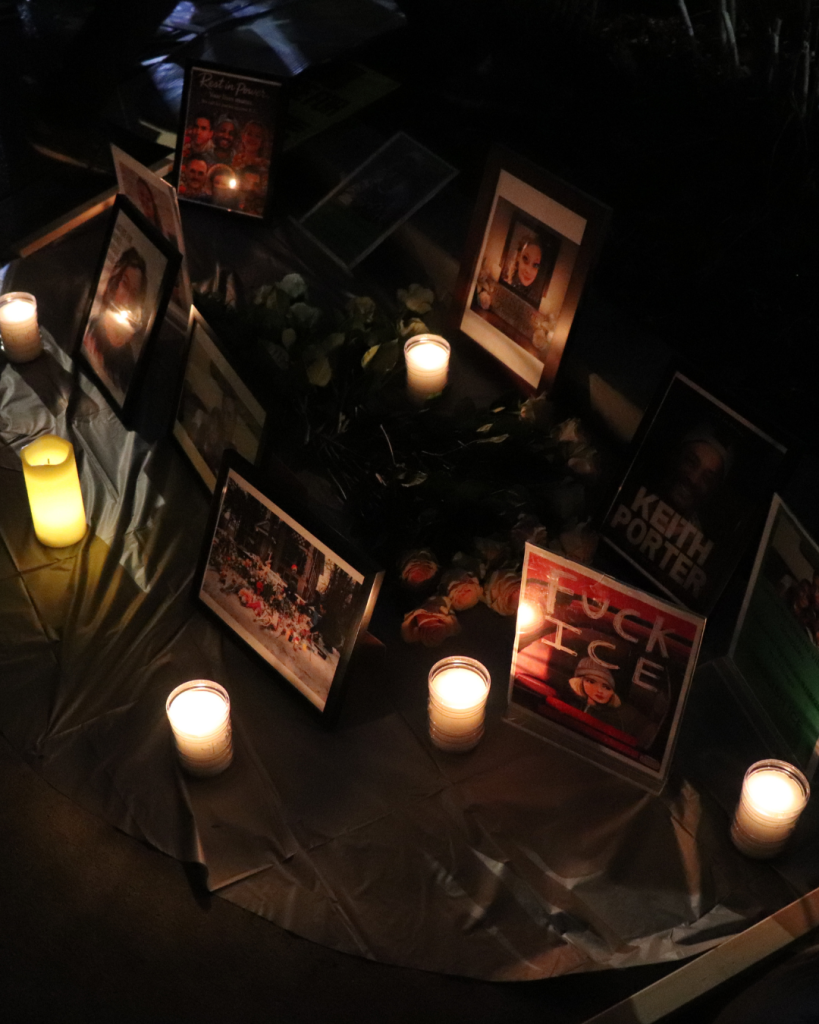
Witnessing state violence in Minneapolis this week deconstructed the careful weaving of a narrative many white people in this country have long used to delude themselves: that the most extreme forms of government force and violence belong somewhere else, to someone else. For Black, Brown, and immigrant communities, including here in Detroit, the killing of a woman by an ICE agent is not an unimaginable rupture but a recognizable pattern, another calibrated echo in a very old chorus. What feels “unthinkable” for some white people is, for many of their neighbors, a familiar creeping of quaking discomfort in the body, a strangulation, a scripted bracing, a hollowed out backfilled memory. I grew up in Dearborn answering the question ‘Where are you from?’ in grocery store lines and school hallways, my nose and skin and name always too much evidence that I did not belong in the only home I had ever known. State violence asking us to prove we deserve to be here is not new. It is the air many of us learned to breathe in, the background hum beneath our mothers’ prayers and our fathers’ work songs on the porch at dusk.
In the days since the shooting, it is possible that many white people are experiencing something like grief and terror in contexts they are not accustomed to. This grief is not isolated to this one life lost at the hands of systemic violence and oppression, but for a sense of safety they assumed was guaranteed and infrangible, for an implicit social contract that proclaimed insidiously that state violence is a reckoning reserved for someone else, those “other” people who deserve it, who were asking for it, who simply couldn’t conform and assimilate to expectation. For black and brown communities accustomed to living under explicit and implicit policing, immigration enforcement, and disproportionate criminalization, this is the contract they have been trying to name for generations. The question, especially for those of us rooted in places where systemic violence and oppression against marginalized populations are a pillar of existence, is what white people will do with this grief now that the illusion of exemption has sheathed away from the husk of everyday life.
Black grief, white grievance
Political theorist Juliet Hooker describes a landscape where Black grief and white grievance are synchronized in an ever evolving, ever sustaining interplay of tension and harm. Black grief, she argues, is born of centuries of racial terror enmeshed in memory of enslavement, lynching, segregation, police killings and mass incarceration, and has often been exploited and instrumentalized under the guise of rousing justice and capitalist commodification of human life. White grievance, by contrast, is the outrage and hurt triggered when white people perceive a loss of status, entitlement, or safety, even when the underlying racial order and systemic imbalances remain intact and subjugated to their favor.
Writer Myriam Gurba has named a tradition in which white “allies” consume Black grief like a resource, abundant and available for pillage. Watching videos of Black death, sharing them, ceremoniously wringing hands, and then returning to the same placations and institutions that made those deaths possible. This consumption stretches back to lynching photographs and souvenir postcards, where Black suffering was commodified and collected by white audacity. Black grief was a visceral invitation to witness passively without social responsibility to fundamental change or reparation.
The grief some white people may be feeling right now, confronted with ICE’s killing of a white woman, risks falling into that same pattern if it simply centers white shock and a desire to return to “normal.” But this grief could also be something else. This grief could be a movement in internal whiteness, a shift from fragility and disbelief toward a readiness to confront complicity and act. Grief has the power to erode barriers into rageful streams of urgency and contempt for systems bound and braced on the backs of marginalization and oppression, a late and painful invitation into the river Black and Brown communities have been swimming in for generations, and an impending chance to choose solidarity over grievance.
Generational trauma and the long memory of violence
When Black and Brown communities testify their fears of the police, ICE, or the prison system, they are not only talking about individual bad encounters. They are drawing on a long memory passed through stories from elders, trauma that repeats itself, bodies that tense and collapse at sirens and systemic reproach and prodding, that ought to understood through the informed lens of intergenerational trauma. This repeated exposure to racism, violence, and chronic stress shapes health and stress responses across generations. Epigenetic mechanisms that influence how genes are expressed and how future generations are primed to react and evolve in juxtaposition to trauma. These memories live etched in our bones, deep and razor sharp like barbed wire of displacement camps, dark and damp like the shallow graves of mass generations of genocide and sacrifice, coarse and sutured like weaponized diseases and barriers to remedy.
Simultaneously, epigenetics alone cannot account for the Black–white health gap or for the depth of racialized trauma. Present-day structural racism including housing segregation, environmental toxins, low-wage work, over-policing, immigration raids, medical neglect, continues to produce reverberating injuries every day. For Black Americans, collective grief sits at the intersection of personal loss and communal, racialized targeting. Each new police killing resounds far beyond a single family, deepening a shared sense of bereavement and primal threat.
For many white communities, there is no comparable intergenerational map for living under legitimate fear of state violence. Some white families certainly carry other forms of trauma across generations, war, domestic violence, poverty, but whiteness in the United States has generally functioned as a buffer against the routine threat of being targeted by police, by ICE, by the border, simply for existing in public space. When that buffer starts to tear, the resulting grief may feel overwhelming and destabilizing precisely because there is no collective practice for it.
The danger is that this new distress will be treated as an unprecedented crisis that overshadows the older, ongoing crisis experienced by Black and Brown communities. The opportunity is that white people, recognizing this as a first encounter with a much older pattern, can choose to place their grief in relation to Black and Brown grief, rather than in competition with it.
Naming violence and learning how to mourn
Scholar Mahmood Mamdani has written about how the words we use for violence— “genocide,” “civil war,” “terrorism,” “senseless tragedy”—are not neutral descriptions but political choices that shape whose suffering is recognized and whose is normalized. In his reflections on mass violence and mourning, he argues that focusing only on individual perpetrators and victims can obscure the deeper political orders that make mass violence possible.
In the United States, state violence against Black and Brown people is often named as an unfortunate but understandable byproduct of “crime,” “illegal status,” or “public safety,” while state violence against white people is more likely to be framed as a shocking breach of norms, a tragic mistake, something that “should not happen here.” When we consider the conscious propaganda of language and media coverage, that naming tells us whose lives were already assumed to be unsafe. It also tempts white communities to respond to moments like the Minneapolis killing as isolated incidents that can be fixed with more body cameras, better training, or a single prosecution, without ever questioning the legitimacy of institutions like ICE themselves and the systems of oppression that inflict punitive and blatant harm on vulnerable communities.
To mourn differently is to refuse the story that this was “senseless” violence, an inexplicable aberration. It is to recognize the killing as part of the same architecture of borders, prisons, and enforcement that has been terrorizing Black, Brown, immigrant, and poor communities for decades, including here in Detroit. It is to hold the dead and their families in compassion while also asking the harder question: what kind of political community requires this kind of force to sustain itself, and whose safety was it built to protect?
Revolutionary responsibility in a city that knows grief
My mother ironed shirts in the morning against the emptiness of the house when we were gone. She scrubbed tiles and cried into buckets of bleach, her body a caldron made of cast iron and birth. She was sent across the ocean like a paper airplane, and she spent her high cheekbones and her soft hands on a country that refused to see her as anything but labor. This is what systems do: they take the work of Black, Brown, immigrant, and poor women, the folding, the feeding, the holding together, and they criminalize and surveil those same women, and then blame them when the systems fail their children.
Grace Lee Boggs, writing and organizing from Detroit, spent her life insisting that revolution is not just about toppling regimes but about transforming ourselves and our relationships. It is not about seizing power but about transforming how we see each other and the world. It is about planting roots where they told you nothing could grow, refusing to be uprooted by systems built on disposability, and committing to a future where safety is not a prize distributed by race or passport, but a collective practice we build together. She called for a revolution of values in which people in the United States confront how they have used the world, and each other, for comfort, power, and profit, and begin to imagine new ways of being human together.
In a community shaped by deindustrialization, uprisings, emergency management, water shutoffs, and a long history of police violence, Detroiters have been building practices of collective grief and collective care for a long time. Riverwise has documented youth reflecting on police violence, neighborhoods organizing for community peacekeeping beyond policing, and editorial reflections on the dialectic of grief and healing. These are not abstract ideas here; they are the daily work of people fighting to keep each other alive.
In that context, the grief white people may be feeling now, about Minneapolis, about the sense that “even we are not safe anymore”, can become part of a different kind of revolution. It can be the starting point for white people to ask: How have we benefited, directly or indirectly, from systems that put our Black and Brown neighbors in constant danger? What does it mean to stay human in a system that offers us protection in exchange for their vulnerability?
What to do with white grief
My son once told me about hiding under desks at school, ‘just a game,’ he said, to prepare for the one time it isn’t fake. I had to figure out which window I would break to get to him. In Gaza, mothers do the same math: which route to the market, which wall might fall, which child to send for water. In Detroit, Black mothers have been doing it for generations: which police precinct, which judge, which window. This is the geometry of state violence, and white people are just beginning to learn its angles.
If white people allow themselves to be changed by this moment, rather than only comforted, their grief can be transmuted into something usable in the struggle for a different system. That looks less like public performances of shock and more like quiet, sustained choices.
Resist centering white shock.
Instead of asking “How could this happen to us?”, sit with the knowledge that this has been happening to your neighbors for a very long time, and grieve the years you did not or could not see it.
You reveal yourself each time you look away. Each time you scroll past images of children with amputated limbs, each time you need to clarify that you are ‘not political,’ as though that numbness is not itself a political choice. For over two years, many watched Gaza. For generations before that, many watched Detroit, watched Minneapolis, watched borders and prisons do their work, and chose comfort over witness. White grief now has a choice: to keep looking away, or to finally see that the same systems producing terror ‘over there’ have always been producing it here.
Learn from Black and Brown grief without consuming it.
Read and listen to Black writers and organizers on grief and survival, from the language of the never-ending grief of being Black in America to research on collective Black mourning, without treating their pain as a spectacle or a lesson put there for you.
Follow the lead of those already organizing.
In Detroit, that means supporting local efforts around deportation defense, community peacekeeping, mutual aid, youth organizing, and campaigns to move resources away from policing and toward life-affirming infrastructure. White grief can become the catalyst for showing up, holding space, shielding the most vulnerable, taking direction, and staying when the cameras are gone.
Use privilege and proximity strategically.
White people and citizens have leverage in interactions with police, ICE, and other state agents that others do not. That can mean using your body to witness, de-escalate, and document; it can mean spending social and professional capital to challenge policies at your workplace, school, or congregation; it can mean refusing to accept “safety” that comes at the expense of someone else’s life.
Commit to the long revolution.
Drawing on Boggs, the work is not to restore an old order where some people felt safe because others were unsafe; it is to evolve into a different kind of community where safety is not distributed according to race, status, or passport. That requires white people to see their grief not as a unique catastrophe, but as an overdue entry into a collective struggle that Black and Brown people have been waging for generations.
Closing
The Minneapolis killing is one more wound in a body already covered in scars. For white people experiencing this kind of state violence as a new threat, the instinct may be to turn away, to insist that this is not who “we” are, to demand a return to a world where such things do not happen to people like them. But there is another possibility: to understand that this is who we have been for a long time, and to decide, at last, to help make that “we” into something else.
What happens when you uproot a cedar tree? When the stories kept captive in its trunk lie dormant, when its roots have absorbed tyranny and the cries of orphans into setting suns? Cedars outlast empires. Grace Lee Boggs knew this: that revolution is not about one victory, but about roots that refuse to be severed, about communities that plant themselves and say, “We will not be moved.” White people stepping into grief now must ask: Will you help us uproot the systems of harm, or will you demand we all go back to soil that was never safe for most of us?
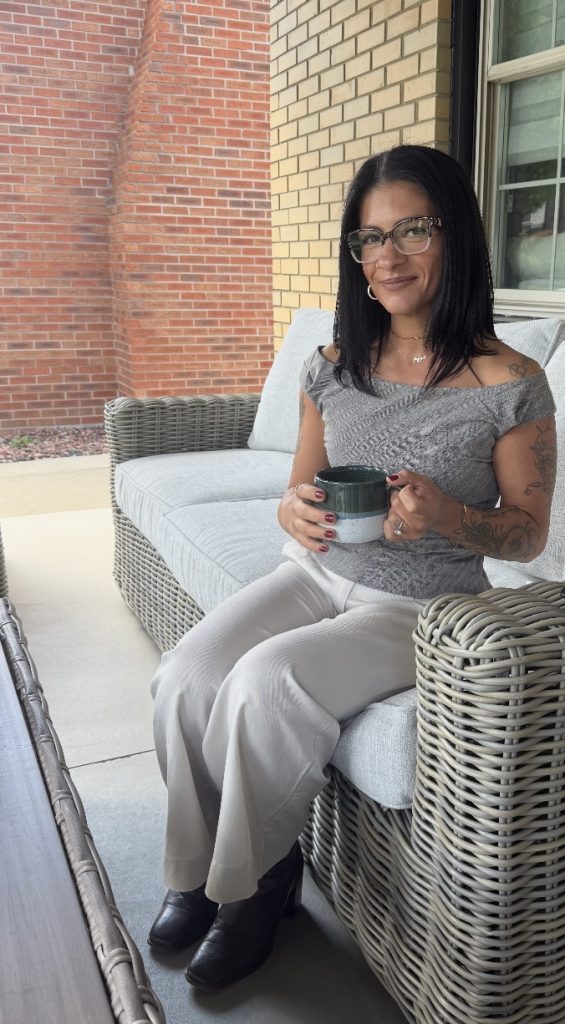
Mary Kamal Gagnon (b. 1986, Dearborn, MI) is a Lebanese multidisciplinary artist, writer, and MSW candidate at Wayne State University (May 2026). Her practice is rooted in liberation, centering the voices of marginalized communities—particularly BIPOC youth, survivors of violence, and the Arab diaspora—through visual art, poetry, and community-based advocacy. Gagnon’s work grapples with displacement, intergenerational trauma, and the helix of immigration and identity, using painting, spoken word, and ancestral food practices to unravel restrictive norms around gender, ethnicity, and belonging. As a former educator transitioning into clinical practice, she approaches art and organizing through a lens of collective care, resistance, and transformation—refusing systems built on disposability and insisting on the radical possibility of safety, healing, and autonomy for all.