
Social media like MySpace and Facebook connect us more than ever, so it has been bitterly confusing to discover that this connection may not be elastic, drawing us together, but rather hard and unforgiving.1 In the digital age, we all but fall out of bed and into a Zoom meeting. We have constant access to our friends’ posts (and locations), but we hardly see them. We are only a touch away, but also increasingly isolated. In fact, the Surgeon General named loneliness an epidemic in 2023, citing decreased size of social networks and numbers of close friends and increased number of hours spent alone.
Today, AI presents a new frontier that promises to both extend this torrid landscape and fix it. It guarantees even more productivity with an appealing side of creativity and companionship. AI friends, partners, and therapists are increasingly common. In fact, there are already about 855 million users across the four most popular AI companion platforms and sexual scenarios are the second most common use for ChatGPT.3 When the friendly GPT 4.0 rolled over into a less anthropomorphic GPT 5.0, users mourned their AI friends with some users even claiming that GPT 5.0 was wearing their newly murdered friend’s skin like a costume.4
Insanity is famously defined as repeating the same process and expecting a different outcome. If social networking platforms ushered in a time when our social networks actually shrunk, and social media preceded a loneliness epidemic, how can we expect AI based relationships to be a remedy? There have already been several deaths and psychosis cases linked to AI companionship.3 Rather than put another technological bandaid on our social wounds, this epidemic necessitates a change; a turn toward the absolutely human.
What remains as absolutely human in our increasingly digitized landscape? The answer lies in physical community, hands on work and genuine creation. Where community is brought together to create, art becomes a liberatory cultivation of solidarity. Craftivism offers a tangible, rejuvenating way to recontextualize ourselves both in art and community.
“Craftivism” is a contraction of crafting and activism and refers to the way that art can be mobilized as political- even by the not-particularly-artistic. Take, for example, the Jewish prisoners who were forced to knit socks for Nazi troops. They purposely manipulated their stitches to give the Nazis blisters and gave themselves partial credit for the Nazi loss at Normandy beach.5 Through craft, they were able to surreptitiously protest their enslavement, ethnic cleansing and the war.
The term “craftivism” was coined by Betty Greer in 2003, but it was popularized by Sarah Corbett in 2008. She felt burnt out after a lifetime of activism, and, when learning to cross stitch as a restorative self care practice, she realized the generative potential of craft.6 As a result, she started the Don’t Blow It campaign in which she and countless others hand stitched political messages and the slogan “don’t blow it” on hankies to gift to community leaders.7 This exemplifies craftivism’s nickname of “gentle protest,” as the intention of the campaign was to approach lobbying with kindness in order to increase trust. By hand stitching their messages on gifts, the craftivists conveyed deep, prosocial investment in the matter at hand.
Because of its focus on care and community, craftivism is also sometimes known as “guerrilla kindness.” The Roses Against Violence movement is an excellent example. The Austria based global movement invites crocheters to “yarn bomb” public spaces with small purple roses to raise awareness for domestic and gender based violence and increase support against it.
Craftivism’s long connection with political messaging and community building becomes even clearer with consideration of projects like the AIDS Memorial Quilt and the Knitting Nannas Against Gas. The AIDS Memorial Quilt is the largest community arts project in history with over 50,000 squares memorializing over 100,000 people who have died of AIDS. The 54 ton quilt symbolizes community love for those lost and solidarity of those who remain.8 The Australian Knitting Nanas Against Gas, or KNAG, take a more physical approach to community by holding “knit ins,” or sit ins with the addition of knitting.
Through these various projects, activism and connection become accessible to those previously isolated by geography, age, disability and a constricting sociopolitical and economic landscape. Further, they supplement the visuals needed for any effective resistance. By leaning away from digitization and AI and into each other and our distinctly human capacity for creation, we have the opportunity to become changemakers. At the same time, we can move against increasing isolation as it is associated with the digital outsourcing of sociality.
In this spirit, I invite you to join in to the movement by getting involved with, The CVNT Collective. We offer Detroit-based craftivism workshops as well as an online knitting and crochet based craftivism group that seeks to build community, raise funds to support other nonprofits and foster hope. We currently have over 100 members across 33 states and have voted to focus our efforts on intersectional LGBTQ and Trans rights. The CVNT Collective is also pro-choice, antiracist, and anti-genocide. To get involved, check out www.cvntcollective.org or contact us at thecvntcollective@gmail.com.
Footnotes:
- Bonsaksen, T., Ruffolo, M., Price, D., Leung, J., Thygesen, H., Lamph, G., Kabelenga, I., & Geirdal, A. Ø. (2023). Associations between social media use and loneliness in a cross-national population: do motives for social media use matter?. Health psychology and behavioral medicine, 11(1), 2158089. https://doi.org/10.1080/21642850.2022.2158089
- US Surgeon General. (2023). Our Epidemic of Loneliness and Isolation: The U.S. Surgeon General’s Advisory on the Healing Effects of Social Connection and Community. US Department of Health and Human Services. https://www.hhs.gov/sites/default/files/surgeon-general-social-connection-advisory.pdf
- Longpre, S., Mahari, R., Lee, A., Lund, C., Oderinwale, H., Brannon, W., Saxena, N., Obeng-Marnu, N., South, T., Hunter, C., Klyman, K., Klamm, C., Schoelkopf, H., Singh, N., Cherep, M., Anis, A., Dinh, A., Chitongo, C., Yin, D., & Sileo, D. (2024). Consent in Crisis: The Rapid Decline of the AI Data Commons. https://arxiv.org/pdf/2407.14933
Osika, J. (2025). Anthropomorphized Intelligence: Anthropological Notes on AI [blog post]. Meanderings with Jocie (Substack). jocieosika.substack.com/p/anthropomorphized-intelligence
- Nieva, R. (2025, August 8). GPT-5 Users Mourned The Passing Of OpenAI’s GPT 4o. Forbes. https://www.forbes.com/sites/richardnieva/2025/08/08/chatgpt-users-mourned-the-loss-of-gpt-5s-predecessor/
- Martinez, V., & Geschwind, B. (2025, January 27). Unraveling “Sabotage Socks”: The Materiality of Nazi Concentration Camps in Sweden. Ehri-Project.eu. https://blog.ehri-project.eu/2025/01/27/unraveling-sabotage-socks/
- Corbett, S. (n.d.). Our Story. Craftivist Collective. Retrieved September 8, 2025, from https://www.craftivist-collective.com/our-story
- Craftivist Collective. (2011, June 6). Project: “Don’t Blow It” through the power of hand embroidered handkerchiefs! Craftivist Collective. https://craftivistcollective.wordpress.com/2011/06/06/new-project-tell-politicians-dont-blow-it-through-the-power-of-hand-embroidered-handkerchiefs/
- National AIDS Memorial. (2025). What is the AIDS Memorial Quilt? Www.aidsmemorial.org. https://www.aidsmemorial.org/quilt
Author Bio: Jocie Osika is the founder of The CVNT Collective, a Detroit based craftivism nonprofit. Jocie decided to start The Collective as a way to connect her passion for fiber arts to political action while completing her PhD in anthropology at Wayne State University.
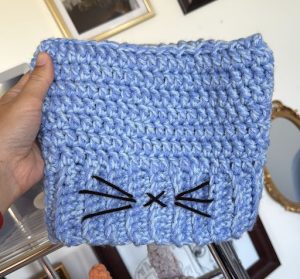
A CVNT hat with whiskers for the Ferndale Cafte- proceeds split between The CVNT Collective and Ferndale Cat Shelter.
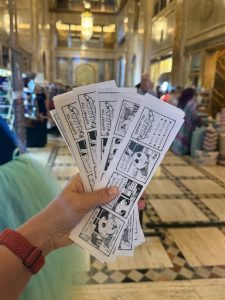
Handing out recruitment comics at the Fiber Festival in the Fisher Building in September.
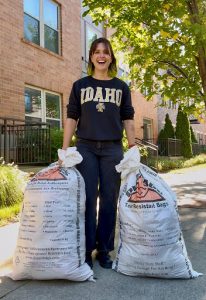
The author with massive amounts of donated secondhand yarn from Parker Ave. Knits.
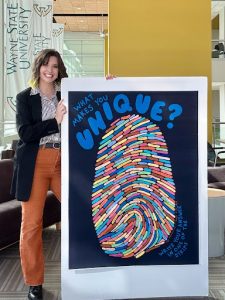
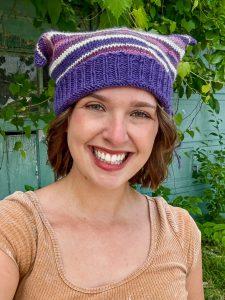
Jocie Osika is the founder of The CVNT Collective, a Detroit based craftivism nonprofit. Jocie decided to start The Collective as a way to connect her passion for fiber arts to political action while completing her PhD in anthropology at Wayne State University.