

“Technology is the answer… but what was the question?” -Cedric Price, 1966
Let us sing to the spirits of storytelling and give our thanks to our ancestors for sharing this Greek myth:
After Hera, Goddess of childbirth, gave birth to Hephaestus, she was so disgusted with his appearance, she cast him off of Mount Olympus, the home of the Gods.
In his rage, Hephaestus used his blacksmith and fire skills to build an incredible technological wonder to trap Hera: a golden throne.
Hera was entranced by the golden throne and could not resist sitting down. The throne bound her, making it impossible for her to leave.
No one on Mount Olympus could help her. Hephaestus was called.
At first he refused, but Dionysus, God of wine, got Hephaestus drunk and carried him to Mount Olympus on a mule.
Hephaestus demanded marriage to Aphrodite, Goddess of Beauty, in exchange for freeing Hera.
They married, and Aphrodite continued to engage in affairs with others.
Some consider Hephaestus the God of Technology, and perhaps we can imagine the golden throne as the golden phone.
Part of me wonders about the origins of where our technologies have come from.
Are they built with compassion, curiosity, and abundance?
Or are they built with revenge, loneliness, and control?
In a fit of wide-eyed hope, I’ve started an initiative with some friends called the Relational Tech Project (RTP). We’re crafting a space where people can explore what it means to build and remix software as an act of care, where technology is made to enhance, not replace, relationships and where the process of creation itself deepens relationships, so we can discover and respond to the true needs of a place.
We’re navigating what it means to make small is beautiful tech in a worldview that assumes that ‘tech’ must be like the myth of the Golden Throne: synonymous with trapping people, optimizing personal gain, scaling at all costs, and reducing the nuance and complexity of messy human relationships to vanity metrics.
We dream about how to make joyful tech.

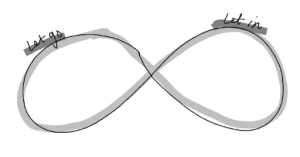
To welcome all emotions, I think it starts with a little forgiveness, to let go in order to let in.
People often ask me about my black & white iPhone screen. I explain that I’m too weak to resist the phone colors stimulating dopamine in the brain that lead to more addictive behavior. Some people immediately ask if I can help them change their phone, but most people just confess that they could never do that and have a guilty tone. I can see they blame themselves.
The thing is, billions of dollars have been spent to hire the most renowned cognitive, behavioral, psychological experts, designers, engineers, and data scientists to build a device that captures YOUR attention. It shouldn’t be a surprise that we cannot just defeat the device by sheer willpower, and I haven’t been surprised by my friends switching to feature phones.
We must let go and forgive ourselves for our lack of control over our screentime.
We must let go and forgive ourselves for our inconsistencies, whether our reply rate, multi-tasking distractions, or doomscrolling.
We must let go and forgive ourselves for our Pavlovian response to immediately check notifications.
We must let go and forgive ourselves for our helplessness as we watch loved ones disappear into their devices.
In my journey to let go and let in reimagined relationships with technology, I’ve been fortunate to learn from elders about ancient forgiveness practices. Like all meaningful transformations, the body and heart matter as much as the head: the heat and prostrations of sweat lodges or the friction and embodiment of brushing from beings more powerful than us, like cedar boughs and eagle feathers.
It is unsurprising that many of us often straddle the contradictory somatic feelings of wanting to smash our phones to pieces yet struggle to leave the house without it. How do we soften these extremes?
The Hawai’ian practice of ho’oponopono was one of the first forgiveness ceremonies I learned about – but I admit I have not had the chance to experience it with an elder, so I explore through descriptions.
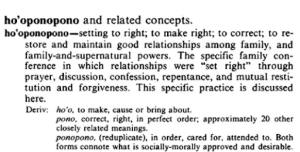

From: Nānā i ke kumu (Look to the source). Vol. I
Ho’oponopono is not a standard step-by-step methodology to apply to any grievance without context. It requires an elder skilled in the practice to facilitate. Usually, it consists of some combination of the following:
 From: Nānā i ke kumu (Look to the source). Vol. I
Some ‘lower 48’ interpretations simplify this forgiveness practice to these four phrases:

In these times of need, perhaps we can build from these simplifications to transition our current relationship with technology into a new paradigm:
Who is sorry for how we currently relate to the technologies we humans have built? And what are they sorry for?
Who or what needs to be forgiven?
Who or what needs to be thanked?
Who is in need of love?
Because justice is love, and it’s high time we had some technology justice.
Maybe we can think about these questions from the perspectives of Hera, Hephaestus, Aphrodite, Zeus, and Mount Olympus the mountain and heavens themselves: what can they let go of, as individuals and as groups?
We can find answers in all our life myths.
How do we listen?
Many other questions remain, and I’d love to hear yours: deborah@relationaltechproject.org or @detien.bsky.social

Deborah Tien (takes any pronoun spoken with love) was born and raised in the suburb of Troy. Presently letting in nomadism and exploring what it means to steward without ownership and to heal our relationships with each other to craft relational tech. Deborah is in gratitude to many, and for this piece would like to give special thanks to two friends: folklorist Oliver Hillenkamp for the Golden Throne myth suggestion and sacred/civic placemaker Daniel Pryfogle for the reminders to let go to let in.