
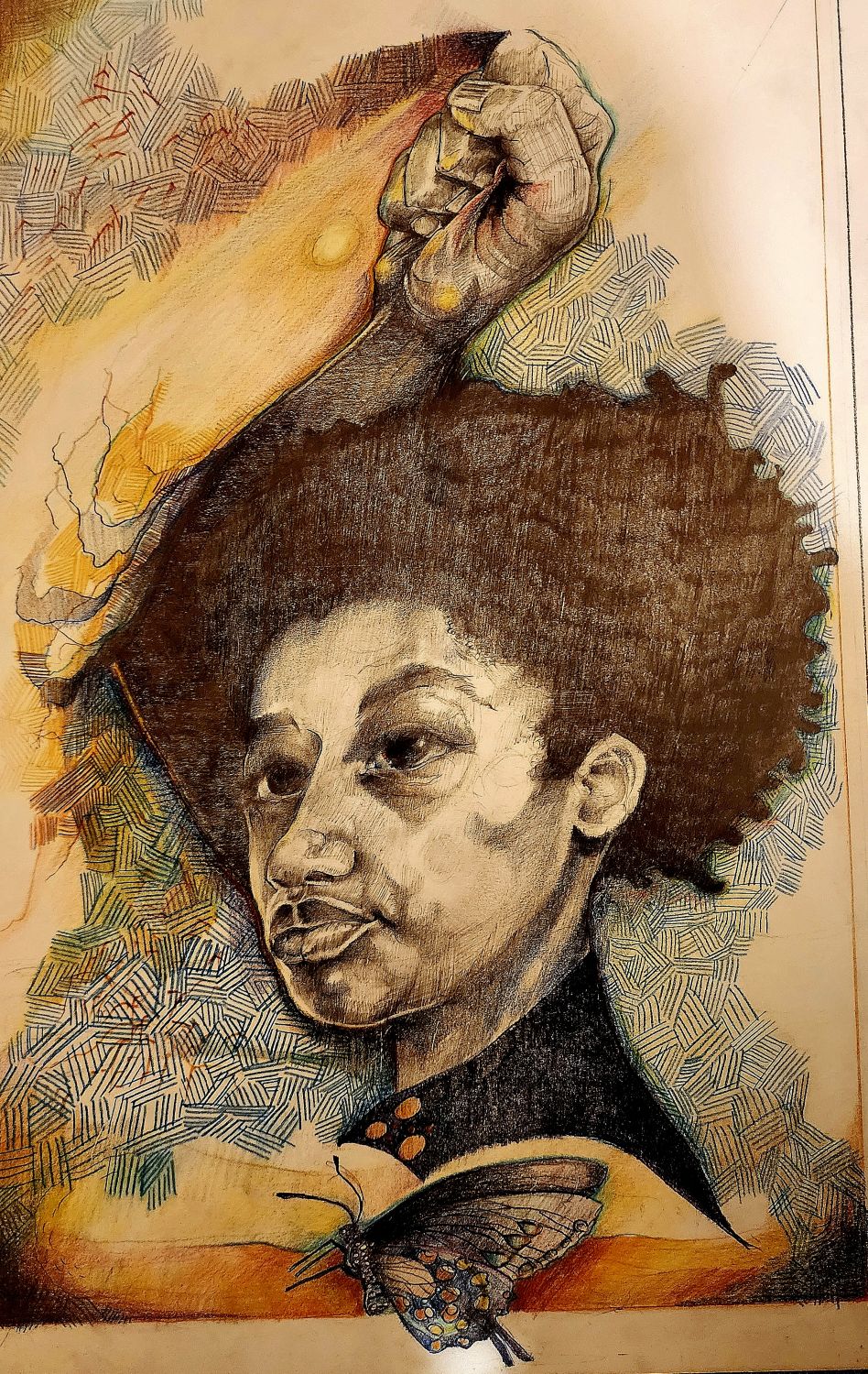
I don’t like explaining my work. I like to leave it up to people to decide.I like to joke that their interpretation is usually better than mine.
If I have anything to say right now, it’s not so much about the picture itself, but about our practice of revolutionary art, culture, consciousness, and movement.
How do revolutionary culture and revolutionary community support each other? It seems to me that culture is what we do to sustain our existence beyond our basic material needs. It is how we grow, transform, and project into the future — while staying rooted in our familial and revolutionary origins and ancestors.
Like a butterfly, we are changed and transformed through the cocoons of culture and consciousness that surround us. Our interactions with revolutionary art and revolutionary movements nurture the gooey soup of our transformation.
It is not always clear to viewers the gender of the characters I draw. I used to get upset when people misunderstood their gender presentation. I felt like I had to put an earring on someone just to indicate womanhood. Until my beloved and very adult child Curtis told me, “Baba, gender doesn’t matter like that anymore. Why should it?”
After all, when people ask my pronouns, I always tell them “iamWe.” I feel like it slides over people’s heads, especially when they just nod without trying to understand it further. But I’ve never identified with the violence and sense of ownership that comes from patriarchy and I don’t like to reflect that in my work.
And so, like the meaning of the picture, I leave it up to viewers to figure out the character’s genders. Or to learn not to care at all, and ponder the multitudes of possible gender expressions and what they mean for the larger work.
This was one of the fastest pictures I’ve ever drawn. And if you know me, you know I don’t usually draw fast.
The one thing I will say about some of the elements in the picture that I hope viewers might come to see is the heat, the fire, and the smoke that come from the interaction between resistance and that which is being resisted — whether it is an internal contradiction being resolved, or us engaging the antagonisms of the external contradictions around us in capitalism and empire. There is always friction. And from friction, there is heat. From heat, there is transformation.
The other thing I’ll say is about the title of the picture: Driven by the Movement is the title of the recent book by my old friend and comrade from the Detroit Branch of the Black Panther Party — Jonina Abron-Ervin. Jonina was the last editor of the Party’s newspaper, The Black Panther Intercommunal News Service.
Her book lifts the spirit, contradictions, and discipline of the everyday people who kept our liberation struggle alive during the Black Power era.
I originally began this picture as a response to her text. I present it now as an homage to Jonina — and to all of her deep, lasting, and transformational contributions to the Party and to our glocal practice of revolutionary intercommunalism and liberation.
I close with some ideas I’ve been meditating on these past few weeks, as we watch the global corporatocracy and its primary beneficiary, the imperial United States, commit ever more violence, lies, and destruction against our global familia — in Cuba, Venezuela, Iran, Palestine, and across the borders of this so-called country:
revolutionary art
reflects the development
of a revolutionary culture
and a revolutionary culture
reflects the creation
of revolutionary art
and the development
of revolutionary culture and revolutionary art
both reflect the revolutionary zeal and consciousness
of a revolutionary people and our resistance movements
as we create and practice global revolutionary intercommunalism
as a structure of global sustainability
to protect the survival of all biological life
from the deathly hands of empire.
All Power to the People
Peace After Victory
Revolution Until Victory
iamWE
Baba Wayne Curtis
March 2026
Edited by Kristian Davis Bailey