
Featured article from the “Future Beyond Billionaires” exhibit held at Swords into Plowshares Peace Gallery.
I’m writing this to you because you love Detroit; you build communities of care and survival here. I love talking about writing and art with you. We’ve known each other for about a decade, but it still feels like we stand on opposite sides of a generation gap. We’ve been good about staying in connection, meeting and re-meeting each other across illness, employment, community, conflict, and creativity. We live in a city that seems to have more value as a symbol than a place where humans live, breathe, work, cry, pray, and die. Our home is stressed and increasingly unaffordable, yet held up in the media as a success story.
Detroit is a fickle prism with many shifting faces which it reveals and hides. It never holds only a single story; it’s not even a singular city. I hope we can write letters to each other and reveal the Detroits that we know and love; and in doing so, maybe we can better love each other in this powerful place, in this dangerous, deceitful time.
The Black Detroit that raised me was built by Southern migrants escaping legal violence; held down by families busting their asses to eke out dignity from corporate employers who’d exploit and discard them; lifted up by radical political leaders who strategically wielded institutional power in ways that challenged the normality of systemic racism; made of families and folk who worked while maligned in our own local media as inept, corrupt, and violent. The local philanthropic foundations, Kresge included, have invested tens of millions of dollars to “improve the city” and tell stories of a resurrection, the result of which is the city’s much misunderstood slide from an imperfect communal democracy to a creeping corporate domination. I mourn; I actually detest the role that Foundations have played in creating the Detroit we now live in.
No mayor, no city council, no political strategist has been able to stop Detroit’s descent into neoliberalism, which– in the United States’ march to the right– has become like the air we breathe. Neoliberalism emerges here from a specific policy history and spews waves of consequences for how life in the city is experienced. What is neoliberalism in our time when the left organizes against the abuses and violence of the settler state, and the right foments distrust of the state and its conspiracy of elites? The best I can answer is that neoliberalism is the corporate hustle that takes advantage of genuine skepticism, pain and doubt to position corporations, developers, billionaires and privatized entities as the social solutions while also deteriorating public deliberation and decision making as viable options to making anything worthwhile happen.
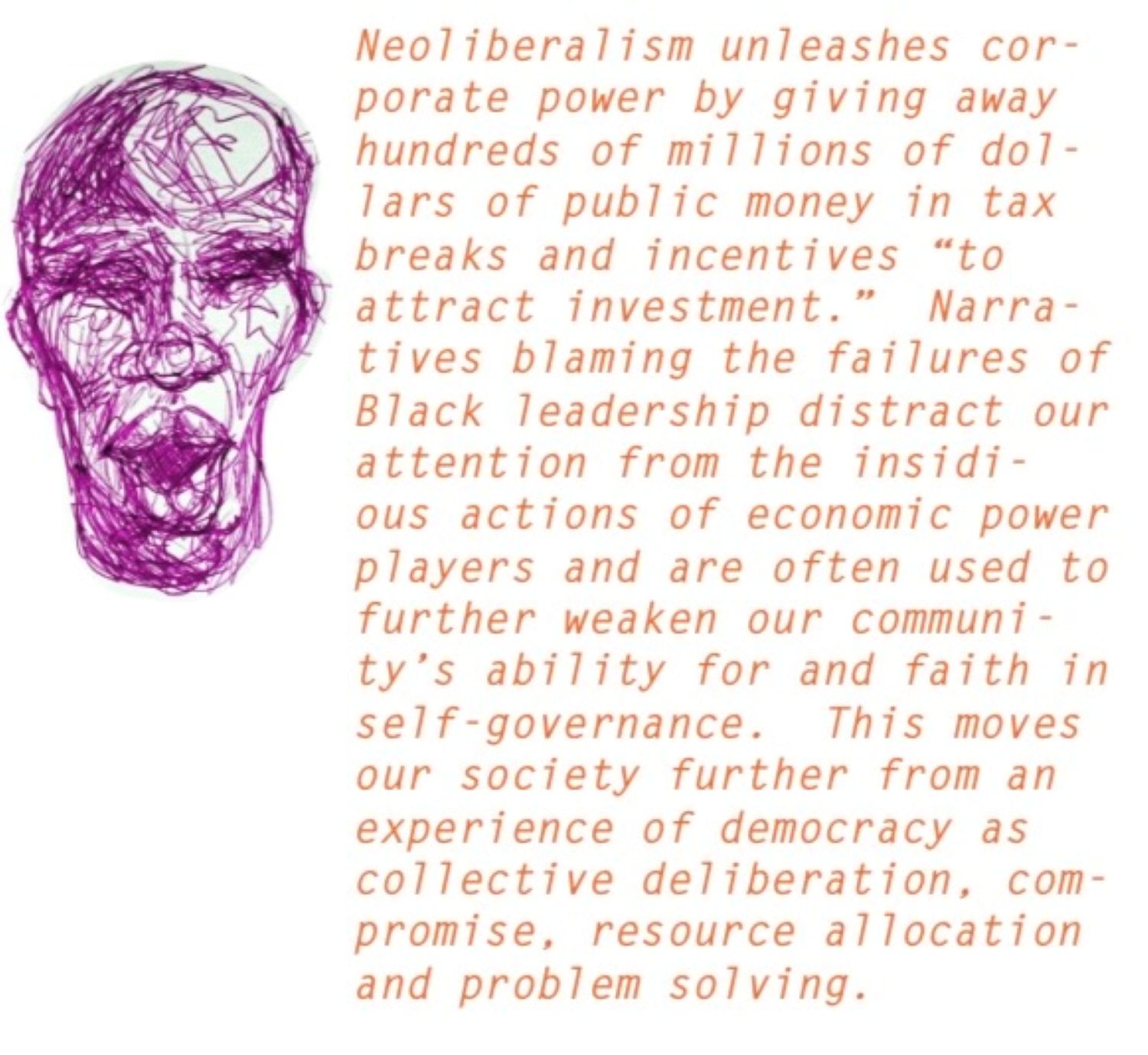
BRYCE PULL QUOTE Neoliberalism unleashes corporate power by giving away hundreds of millions of dollars of public money in tax breaks and incentives “to attract investment.” Narratives blaming the failures of Black leadership distract our attention from the insidious actions of economic power players and are often used to further weaken our community’s ability for and faith in self-governance. This moves our society further from an experience of democracy as collective deliberation, compromise, resource allocation, and problem solving.
This is not a feature of human nature or an organic development. Instead, it’s been an intentional policy attack that has helped the rich get obscenely richer in the last few generations.
I grew up in the remnants of The Motor City during the late 1980s and 1990s, as automakers moved factories to the U.S. and Global South in search of cheaper labor. Globalization (which can be read in many ways as a euphemism for corporate takeover) was in the air, and was the decree for those serious about business. Metro Detroit began calling itself “Automation Alley,” proudly referring to the process by which corporations removed as much blue-collar labor as it could in favor of mechanized production.
What has this meant for a racialized city seeking self determination such as Detroit? It has meant factories closing down, leaving thousands of breadwinners scrambling for new identities and new incomes, and business of all sizes circling their wagons, packing up from the so-called dangerous dark city and moving commercial enterprises to the suburban enclaves. We think of “abandoned buildings” as the result of residential migration or eviction, but the abandonment of Detroit was systemic and multi-leveled. What’s a mayor to do threatened by the loss of essential major revenue?
Theorists such as Jimmy and Grace Lee Boggs foresaw some of these patterns in the 1960s. They challenged Detroit’s politicians to see the coming challenges as human problems and communal problems. They advocated to put in place the type of programs that would help “outsiders” — young low-income, Black and brown folk who were being excluded from labor markets and quality social services– to embody entrepreneurial, communal, and environmental values. Before “mutual aid” was a buzzword, they organized towards putting together programs that would help Detroiters to save each others’ lives and rebuild economies autonomously outside of the globalizing, automating corporations that were already “racing to the bottom.” Jimmy Boggs wrote a controversial essay called “A job ain’t the answer” (1981) where he argued that our community shouldn’t see itself only as a Labor Force, that is a pool of employees within capitalism, but as a community that has the potential to implement new, more humane, economic values.
The stories of all the ways that the State of Michigan impeded Detroit based politicians from implementing strategies based on African-centered values, socialism, ancestral ways of being together, and Southern common sense would require volumes and would justify its own art show and cultural exhibit. Let’s just say, it was not for lack of trying, nor for lack of strategizing from the grassroots to the City Council chambers to the Recorder’s Court bench to the Mayor’s office, to the pages of the Michigan Citizen and back.
So in the twenty-first century, we are left with disenchanted Detroit Mayors and city statesmen who only speak of the city’s problems as financial. And who are only empowered to use the tools that the billionaires, the bankers, the foundations, the corporations allow. We have generations of liberated-minded people who only see “The State” as a tool of empire and only know democracy as an impotent sham or an aggressive violator.
That’s why in 2005 Mayor Kwame Kilpatrick borrowed $1.44 billion, purchasing interest rate swaps from UBS and Merryl Lynch. These financial instruments, high risk loans were of the same type that were so common they instigated 2008’s global financial crisis, yet Kilpatrick, derisively called “the hip hop mayor,” was singled out for his corruption. It was also the insurmountable debt and financial servicing payments from this borrowing which forced Detroit into bankruptcy almost 10 years later.
In the Fall of 2010, Mayor Dave Bing kicked off Detroit Works, claiming that population loss stemming from abandonment required that the city “right size.” Residents raised opposition to forced downsizing, noting that the plans offered no support for relocation, no assistance to renters or homeowners with declining property values, only the threat to cut essential services from low-density neighborhoods. Detroit Works began to feel pressure to include “community input.”
Public Act 4 authorized the “consent agreement takeover” of the City Council. It authorized the state to declare an emergency and take over all aspects of city government. Elected officials were replaced by state-appointed Emergency Managers who claimed total decision making and governance, which included any spending whatsoever. In November 2012, voters struck down this law in a statewide referendum.
In December 2012, the State Legislature passed Public Act 436, the Local Financial Stability and Choice Act, to make emergency management state law, this time with technical features that made it ineligible to be revoked by state referendum.
During that time of declared financial emergency the State of Michigan continued withholding revenue sharing from the city.
In February 2013, the state government named Kevyn Orr as the Emergency Financial Manager for the city. By July of the following year, Orr had filed for bankruptcy, the largest municipal filing in US history. The Grand Bargain brought the city out of bankruptcy. Some of its effects included: transfer of ownership of the Detroit Institute of Arts to a private non profit; closing down the city owned Joe Louis Arena, home of the Detroit Red Wings and allowing a private entity to own the new arena and surrounding parking; the transfer of the city’s water department (which had brought in revenue by serving millions of customers, about 75% of whom lived in the burbs) to the Great Lakes Water Authority; and the elimination of promised cost-of-living increases for retirees. The city left the bankruptcy proceedings with Foundations ready to invest millions of dollars into selected neighborhoods. Detroit was less capable of bringing in revenue but open for business again in ways that pleased developers, corporations, and billionaires.
Sometimes I hang my head in activist shame because it feels as though their victory has been so thorough, so decisive. I hang my head remembering the times when I’ve been afraid to make the powerful uncomfortable.
So I write you, Young Detroit, in the spirit of friendship, in the spirit of honesty, a gratefully aging movement veteran with light gray growing in my beard who mourns the defeats of the past while remembering how we naively held out hopes that our collaboration could stop the flood of money from Katrina’ing our Black and battered city. Or we held out hopes that we could reroute the money with a People’s Plan, reroute it from those willing to displace those of us with torn up front porches, tarp-covered holes on our roofs, abusive absent landlords, to maximize returns on investments. Or we held out hopes that we could face down capitalism and Detroit could one day soon become a city where human rights were respected, I mean where people could afford food, clothing, water, shelter. Or we held out hopes that our leadership –who sometimes wore all black, sometimes was all Black, sometimes prayed in Sunday best, some days wore patches sewn on our backs, sometimes said “please come as you are,” that sometimes sang and sometimes rapped, that sometimes screamed and sometimes spat, that some days passed out food before meeting because young tummies rumbled and we shamelessly dreamed of a city without shaming, that some days passed out water in giant bins or called up the guy who had the hookup to force the water back on for the hood, that some days cussed and forcefully moaned for our loved ones’ mounting bills; we sometimes held our unkempt tongues and shouted “these mother scrunchers” when our elders and OGs were present– and sometimes we didn’t hold our tongues and we yelled in unison “It’s an Emergency Mother Fucker!” in hope that our myriad leadership could facilitate dignity and memory.
For some, I may have to introduce you to our city. For other friends and community members, this letter may work as a reminder.
Gentrification is today’s colonization. I remember when Detroit was reopening for business, we’d see our New neighbors bringing back our imagery of the Western frontier, calling themselves “conquistadors” to promote their neighborhood business community, lionizing French settlers, or bringing back nostalgia for when Detroit was majority white and functioning as a global business entity.
These gestures carry undertones of warfare, an intent for history to repeat itself, declarations of conquest. I hope this letter between us is something new. I hope these exchanges between generations allow us to stir up new possibilities our enemies cannot foresee. We are cycle breakers, placing our pieces together in our fractured city.
I’m excited to continue these conversations off-grid, off-screen, and off the map. I’m excited to see the maps you stitch together: the guides of care and creativity you produce and the maps of billion-dollar players, their staff and offices around the globe, and the games they try to play us with.