
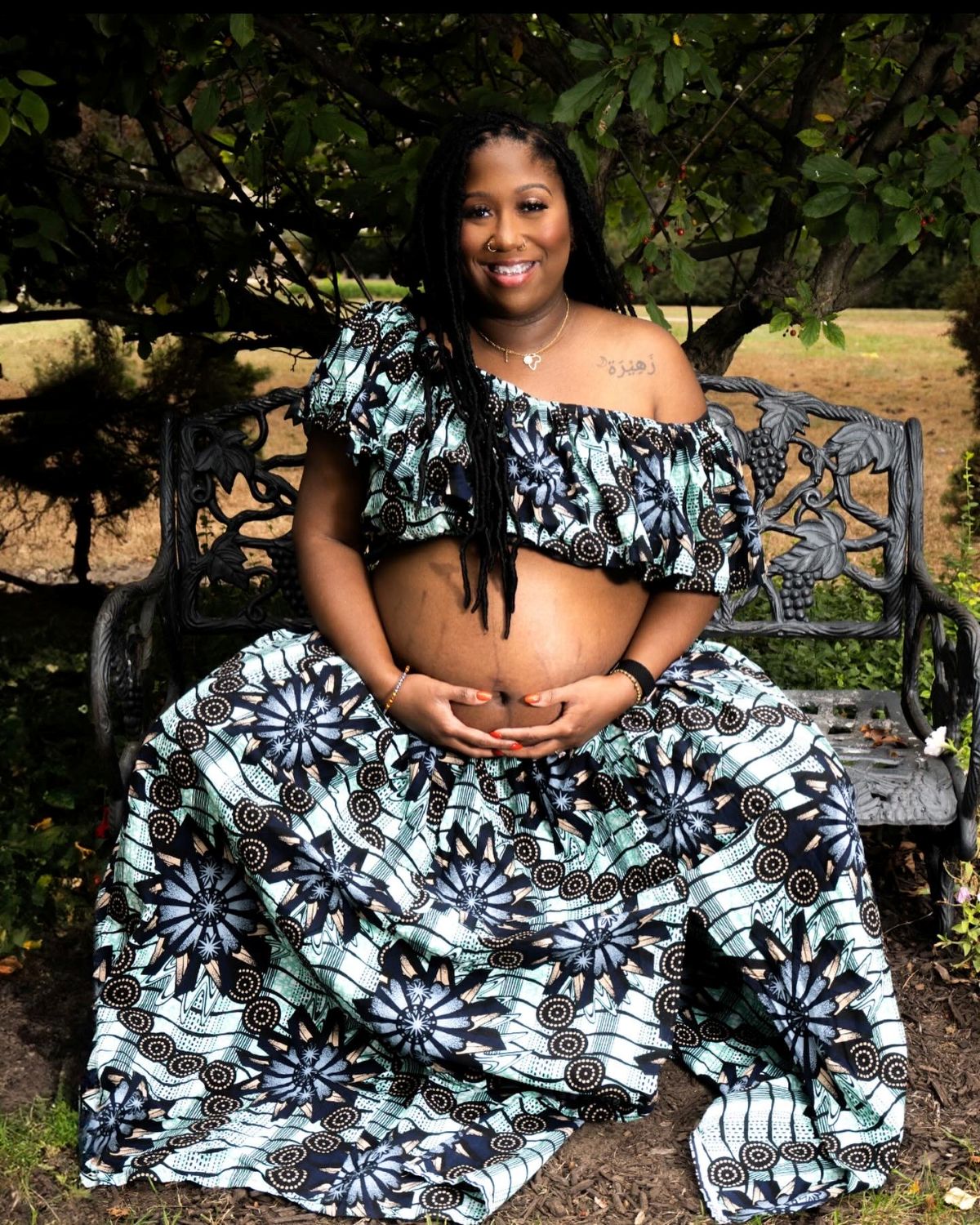
Writer.
Birthworker.
Abọriṣa
Abolitionist.
Mother.
All of my identities are grounded in birth, transformation, and new ways of being.
In my youth, I considered myself an activist. As a younger woman, I considered myself an artist. After birthing children whom I wanted to inherit a free and just world, I began to recognize that there is no liberation without organizing. I’ve been more intentional about learning the ways of organizers and connecting with the folks co-leading the work. I don’t proclaim to be an organizer just yet. The day will soon come. Nevertheless, I’ve been more intentional about building community.
But I’ve got to be honest.
It’s been difficult.
Difficult to build that trusted community in a society that does not honor or respect mothers, does not help build guardrails for mothers and antagonizes mothers, especially Black mothers.
While being a mother has catapulted me to figure out my place in movement and has further radicalized me, I find that the demands of motherhood in a Western world have also kept me out of movement. Working traditional jobs and often for employers who do not value the time or capacity of mothers and the patriarchal design of our world, which demands that mothers fulfill the majority of household duties while functioning as the primary parent, leaves mothers feeling too exhausted to create, too exhausted to organize, too exhausted to resist.
I know that this is intentional.
I also know that we’re not doing this thing right anymore.
As someone who deeply believes in matrilineal healing and kinship, in the sacredness of queering families, in the value of village-rearing, I know mothers weren’t meant to do all that we do alone. I am married, but still feel the pressure to meet so many unreasonable expectations as a mother. My husband is amazing, but patriarchy still allows him to move through the world differently than I. It gives him a degree of permission.
Black mothers have always resisted. Black mothers have always made something out of nothing. Black mothers have been magicians. Black mothers have been birthers and builders. To survive, Black mothers built family, built sacred community with those not of their own blood. Black mothers made a lifeline. Yet, Black mothers have been pathologized, criminalized, and shamed. Through stereotypical media, through insidious policy that has ruptured ed our interpersonal relationships, through faulty narratives that don’t interrogate community breakdown from racialized, gendered, and historical perspectives. Somewhere along the way, we were taught that we needed to be strong. Somewhere along the way, we were taught to do it only within the context of the nuclear family. Somewhere along the way, we were taught that we needed to do it alone or only with the additional aid of a male partner’s hands.
And we believed it.
It took me about 6 years to complete my Master’s in Communications Studies at Wayne State University. I started the program as a single mother of one and ended it as a married mother of 3. My lived experience had expanded so much that I’m honestly glad it took me so long to finish. I was fortunate to have two classes with Dr. Jessica D. Moorman during my last two semesters. I finished my last exam while in labor with my third child and completed the course just a few months postpartum. I can admit that I really tested my body that season, but I was determined to finish the course on time because I loved it so much. Dr. Moorman’s courses changed my life. I’m sure this sounds cliché, and I’m okay with that.
I spent the last semester learning about how stigma, discrimination and bias inform our worldviews and how we interact with the world around us. The idea of shame came up a lot in my research and analysis. I thought about how shame makes us feel othered, makes us struggle to feel a sense of belonging, makes it difficult for us to experience intimacy and makes us disconnect from community. Stigma, discrimination and bias also perpetuate binaries, and the idea that we have to do, be and perform in specific ways. I believe this trio is largely responsible for convincing Black mothers that family needed to be curated within a limited binary and that support should only be accessed in “acceptable” ways, ways that minimized the value and necessity of the kinships we’d previously built out of survival and out of tradition.
As I prepared to wrap up the final course, I thought about what Black women, Black mothers, have internalized decade after decade after decade. I thought about how so many of us have accepted the notion that we are unworthy of support, regardless of the unrelenting demands on our lives.
That course was life-affirming for me and reminded me that I didn’t create the silo, but I can help to destroy it.
I won’t be subjected to self-silence. I’m saying exactly what I, and so many of us, need. In recreating, or returning, to these systems of survival, these ways of living and loving, these ways of honoring chosen families and expansive kinship, I’ve recognized what we may need to lean more deeply into movement work. We need:
- More care and tenderness for mothers
- A stronger commitment to curating more egalitarian partnerships and divestment from the notion that mothers have to do and be all
- Trust to share our children more beautifully (to build caregiving capacity)
- Spaces designed with mothers in mind
These items are bound by trust, and trust comes from an alignment of values. There has to be community agreements that honor health and safety for mothers and children.
As a Black queer feminist and abolitionist, I aim to see my children as full human beings with agency. I aim to see them as comrades. With that, I respect them and only want them to be cared for by people who respect them.
Right now, my Mother is typically the only one who cares for my children. I trust her fully because of the way she curated safety for us as children. Without even knowing it, she raised the health of our community; she set expectations around emotional and spiritual safety. She required that people call me beautiful and not just “for a dark girl.” She made sure they knew my 4c hair was a crown of glory, not a “nappy mess.” She did the work. She led the conversations and then built a village for us so that she could show up as a phenomenal educator, administrator, and advocate. And she showed up for the children she taught, seeing their humanity and worth in ways many of them had not experienced.
My mother is the foundation. She is my first teacher and an amazing caregiver to my children, and still, to me. But she is one. To do this work, we need many.
Learning from my mother has called me to take her work even further. As a responsive and conscious parent, I’ve facilitated conversations with my family, training, if you will, around care, consent, agency and developmental appropriateness. I am fortunate that they’ve been receptive. Perhaps part of my work as a community mama is not only to extend the same expectations to all others, but to offer wisdom so that we can be in community together and feel really good about it.
Years ago, I shared with my therapist my concern about people assuming that I thought my children were too good to experience what so many of us had experienced at the whims of caretakers who didn’t affirm them, who didn’t respect them, who didn’t center their emotional and spiritual well-being as much as their physical. Her response to me was, “They are.” My children are too good, and so are yours. So are all the children.
James Baldwin said, “The children are always ours, every single one of them, all over the globe; and I am beginning to suspect that whoever is incapable of recognizing this may be incapable of morality.”
To be community mamas rearing community babies, we need communities that feel safe. We need communities that see our children as theirs, that love and respect them as theirs, that believe that they are too good for anything less.
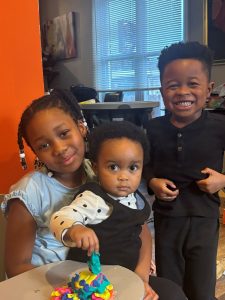
I love my children profoundly. Being a mother has catapulted me back into movement spaces.
Because they deserve a free and just world.
And we only get there by building community.
We get there by creating systems and pods and care for children so that mothers can organize, strategize, and galvanize with more ease because we know our babies are covered.
The demands of motherhood and fear around a lack of safety and care have often kept me distant. I’m moving beyond self-blame and isolation and feeling like I don’t belong. I’m moving to creativity and thinking about how to expand my village to include more chosen family and soft places to land. I’ve decided to explore more ways of being. The children deserve a new world, but it will require that we remind ourselves of the ways of old. It will require us to do what our big mamas, mamas, aunties, and elder cousins did. It will require us to center ourselves in the practices of those like Toni Cade Bambara, who believed in an irresistible revolution. How do we make working towards liberation and revolution irresistible? We create spaces for people, including Black mothers, to show up fully in them. We have so much to offer.
Raina Rising
A practicing doula since 2020, Raina is a mother, aborisa, poet/writer, Black queer feminist, and abolitionist. She holds an M.A. in communications from Wayne State University. Raina believes in using language and communication to empower people through unique storytelling. She also believes in using ancestral wisdom that centers matrilineal healing in her practice. Raina recognizes that all of her identities are grounded in birth, transformation, and new ways of being. Raina believes in resource mobilization and supporting communities most impacted by injustice through strategic communications, narrative and power building, and cultural expression. Of all her titles, what she is most honored to be called is a mother. Raina has three children who consistently teach her new ways of imagining and being.