
Think Detroit in the 1930’s: religious hate radio is being invented here – broadcasting white supremacy and antisemitism; corporate industrialists openly embrace fascism and turn guns first on the homeless and unemployed and eventually on unionizing workers. Meanwhile, the federal government “repatriates” 15,000 Detroiters (a million nationwide), many citizens, back to Mexico. In such a moment hangs the story of (Un)Forgotten: The Murder at the Ford Rouge Plant, a jazz musical revived October 10-12 for its 20th anniversary at the Marygrove Theater.
Of course, the story itself concerns love and solidarity. It’s about listening to the voices of those in the unemployment line. It celebrates the invention of the sit-down strike as a tactic of nonviolent direct action in labor organizing. And it tells of courage and risk, of standing up together, in the face of official violence. So, yes, right on time.
Forgotten is about Rev. Lewis Bradford, the pastor-organizer well-played by Ben Blondy. He was murdered at the Ford Rouge Plant in 1937 while also assistant minister at Central Methodist Church downtown. Presaging the worker-priest movement, he went to work in the plant. From his diary: “[I intend to] make a guided approach toward meeting the spiritual need of Detroit. This should be done at present, through work, not as an evangelist.”
Meanwhile, the Depression was killing people on the streets of Detroit and in the makeshift Hoovervilles down by its tracks. Bradford began the Forgotten Man’s Radio Hour, interviewing people about their lives as they waited in line for soup at the Howard Street Mission. He sings, “When you tell your story/ Hard times are easier to bear/ Step up to the microphone/ If you’ve got something to share.”
His effort had a foil, at the time and in the musical, in Father Coughlin, preaching against “Reds, Jews, and Blacks” through his burgeoning radio empire. He sings, in harmony with his friend Henry Ford, an aficionado of Hitler’s Mein Kampf. The two are joined in the musical’s score by Ford’s enforcer, Harry Bennet, who oversaw a private army of Rouge thugs and was known for such deeds as Bradford’s murder. “Radio, Guns, and Money,” they sing.
The young pastor’s story weaves through Detroit’s remarkable history: the Ford Hunger March, the Battle of the Overpass, as well as the company campaign of terror against the organizing efforts and its tactics to divide workers racially – all are narrated in riffs of jazz song.
Full disclosure: I am no unbiased reviewer of this musical. I confess being entangled as a minor supporter from overture to curtain call. So let me speak personally.
When composer and author Steve Jones, a descendant of Lewis Bradford, first came to Detroit in search of answers, he put out feelers to local Methodist pastors. I invited him to dinner. We talked and shared our histories. In his family tree, Bradford was one of those nagging stories that smell of silencing and cover-up. His wife and child left town abruptly after his death. Foul play and threat? Thus began a personal, spiritual, and musical journey of his own. Immersing himself in Detroit labor history, locating Bradford’s lost journal in an attic and above all getting hold of the autopsy report from which a forensic pathologist in the County Medical Examiner’s office confirmed, “This was no accident – this was a homicide that was never investigated…There’s no way in hell that he fell.” Multiple blunt strikes to the head.
As pieces of the story lit up one at a time, Jones began processing them musically, and before he knew it the opera was emerging at the piano beneath his fingertips – in the chords and idiom of his own heart. My daughter Lucy, then 11, vividly remembers him sitting down to our piano to play the first couple of songs.
But the evening also affected the musical. In sharing our histories, we mentioned a letter I had written from a 60-day stay in the County Jail for nonviolent resistance. Sent to my daughter Lydia, then three years old, it tried to explain why I was so long away. (Her mother Jeanie also made a cloth book entitled, “Why is Daddy in Jail?”). Steve later confided those were the inspiration for a song Bradford intones over his sleeping daughter, “How Can I Explain… to you/ the work I am called to do?/ Healing wounds is my goal/ the world is crying out to be made whole/ We’ve got to change the world/ For me and for you.”
When this 20th anniversary production was first conceived, the first thought was to reunite the original cast in performance. But it quickly came clear that this was an opportunity not only to invite a new cast, but to summon another generation. We are in a moment when our history is not only in danger of being forgotten, but actively suppressed, deleted, banned. A living memory must be shared and passed. For dress rehearsal, the auditorium was filled, admission-free, with students from over 30 Detroit high schools.
One person from the original cast emblematic of this effort was Lynn Marie Smith. She played Rosie, the African American couple who represent not only the Great Migration North orth to the factories, but also the way race was used to divide organizing efforts. Rosie is first to warm to Bradford’s appeal. Gordon Patton, another original cast member who played Rosie’s husband, is one of the few earlier cast members in this production, this time stepping back from lead to join the chorus. His apprentice, Emanie Morgan, used his gospel and blues lessons to rock every number and keep the drumbeat of history alive.
Lynn Marie, dedicated to her role as a mentor, took her protégé for the new Rosie, Sydney Schropshire, for a long walk on Belle Isle to help her think through the character’s backstory, learn the history, and deepen the role. She also served as choreographer and led the whole cast in “meditations” to help create a bridge between the personal and the play. Another mentor was Elise Bryant, UAW cultural worker, who reprised her role as director. In addition, Detroit jazz stalwart Bill Meyer was again music director, his original trio reunited. The elders mentored.
Oh, one more thing. The little girl who listened transfixed at our piano to those first tunes? My daughter, Lucy Wylie-Eggert, sang the part of Bradford’s wife, Ella. Would I be too biased to say she made the jazz score her own? In any event, she is of the generation who now embraces this history as her own.
Cece Sperling, who plays Lewis’s six-year-old daughter, though prominent, speaks very little throughout, but in the end steps solo onto the stage to belt out a song of remembrance for her father, summoning the entire cast in the finale.
Forgive this Methodist pastor if I see a story, not just of recovered memory, but even resurrection. The cast chorus invokes Joe Hill. “Don’t mourn. Organize.” And of Bradford: “We remember you/ We remember you/ What you gave/ What you’ve done/ Will not be Forgotten,” all while a host of ancestors are projected as backdrop – including the labor martyrs, plus, surprise, Grace, Jimmy, Charity Hicks, and more. It is an act of memory we do well to share. The nagging questions of history summon us in this moment. Not to mention the One in whom all ancestors and saints are remembered.
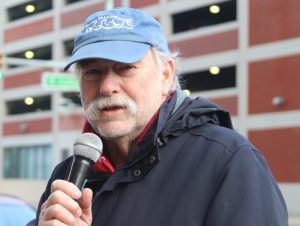
Bill Wylie-Kellermann is a United Methodist pastor retired from St. Peter’s Episcopal Church, a non-violent community activist, author, and teacher from Waawiyatanong/Detroit, now also of the community at Kirkridge, Bangor, PA, on Lenape land. His writing is generally framed by a theology of the “principalities.” And he likes to say that in Jesus, he bets his life on gospel non-violence, good news to the poor, and freedom from the power of death.