
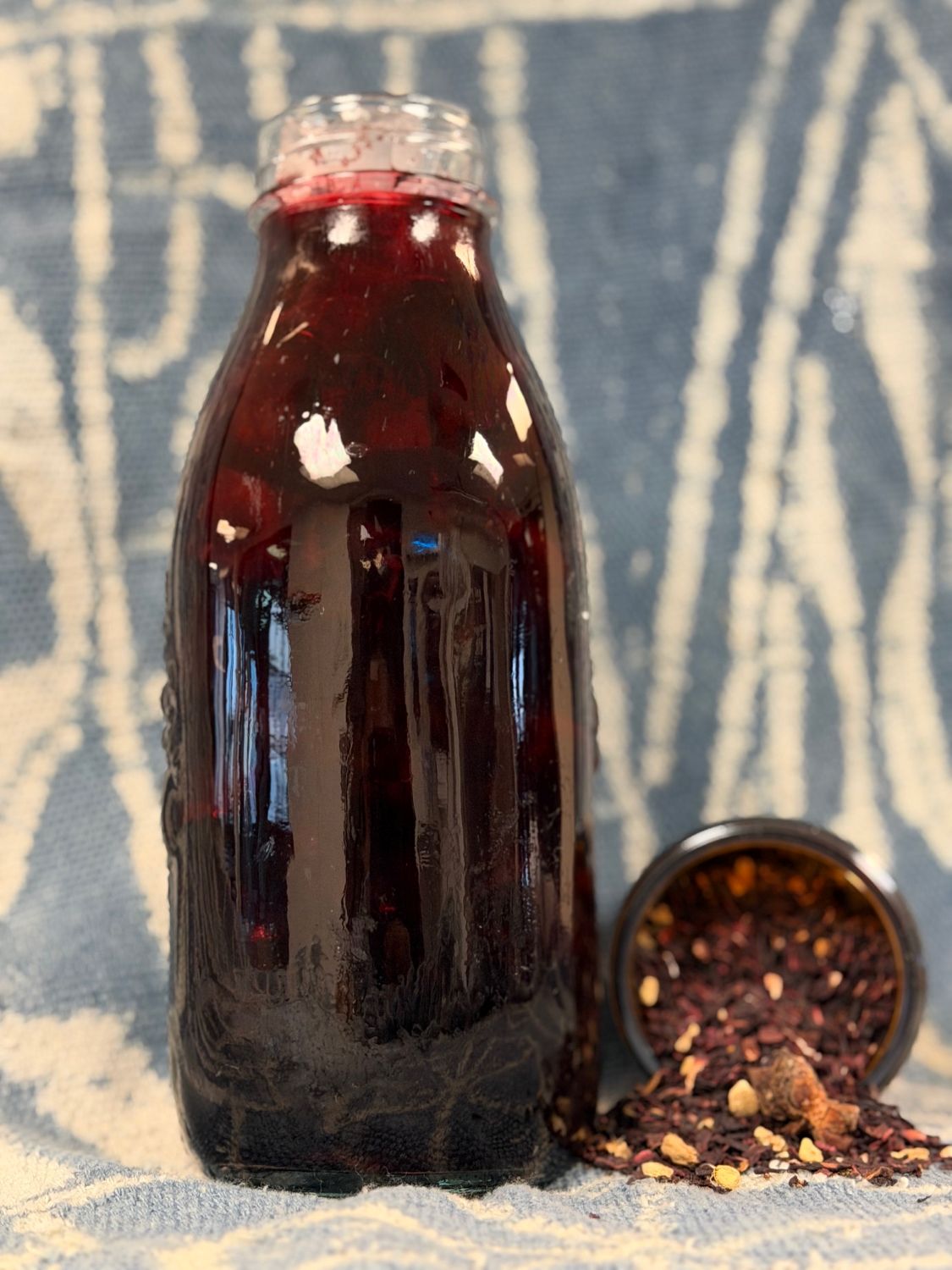
Editor’s Note: This recipe is a part of a series graciously offered from the community inspired kitchen of Josmine Evans, founder of the Detroit based Indigo Culinary Co. We hope you find these offerings that are rooted in critical connections with tradition, history, and our present as delicious, comforting, and healing as we do! Find other offerings from past editions such as Collard Greens, Sweet Potatoes and Peanuts, and Sassafras Tonic at riverwisedetroit.org
Hibiscus came to the Western Hemisphere with West Africans. Before many of us called it hibiscus tea, it had names that reflected its relationship to place: bissap in Senegal, sobolo in Ghana, zobo in Nigeria. It became known as sorrel across the Caribbean and flor de Jamaica in Mexico. In many of these places, the same word names both the plant and the drink. Hibiscus sabdariffa is the variety most commonly used to make hibiscus tea, or more properly, a tisane. It is native to Africa, where it has long been cultivated for flavor and medicinal properties that cool the body, support the blood, and help move fluids through the system that need to be released.
When hibiscus crossed the Atlantic, it moved across the same routes as enslaved Africans, first into the Caribbean and then throughout Central and South America. In Mexico, it became known as flor de Jamaica, as a name that points not to the plant’s botanical origin, but to the people and the routes through which it traveled. And in that context, Jamaica becomes a shorthand shaped by colonial geography and synonymous with Blackness. Like breadcrumbs scattered across the diaspora, everywhere it lands, it is adapted, renamed, and folded into local practices, all the while remaining itself. A cherished and refreshing red floral drink.
Across the Afro-diaspora, red foods carry significant meaning. They appear at gatherings, funerals, and celebrations as symbolic associations with blood, life, continuity, spirit, strength, and vitality. The deep crimson color of hibiscus and its sharp, tart flavor place it at the center of those traditions. That tartness also points to hibiscus’ natural astringent and diuretic qualities (pulling heat and moving fluid in the body). Across cultures, people have developed ways to balance those effects, which is why you will rarely see hibiscus alone. It’s most often supported by warming spices like ginger, clove, cinnamon, allspice, and nutmeg, ingredients that support digestion and balance the embodied experience of consuming hibiscus. It’s the same logic found in soups, stews, and spice layering across diasporic cuisines. The flavor and the medicine go together.
I first met hibiscus through Latin foodways. I met agua de Jamaica in California, always sitting on the counter or on the cart at a taco stand, tucked between horchata and Agua de Tamarindo (which also have African ancestry). It would be much later that I realized that my relationship with hibiscus began long before I was even born.
Gratitude to the indigenous people of the Americas for holding on and safeguarding that inheritance I did not know yet was mine, so that I could come into relationship with it when the time came. This is one of the ways that food works as an archive to preserve and affirm the identities of diasporic peoples.
West Africans and their descendants in the Americas are not the only people in ancient relationship with hibiscus. In Egypt, it is known as karkade. It’s also consumed in Ethiopia, Eritrea, Sudan, Saudi Arabia, Yemen, Palestine, and Iran. There was a time when, after I learned that hibiscus came from Africa, I thought that I had found it. I thought that I had traced it back from California through Mexico, across the Caribbean, and into West Africa, and could finally say: ‘There it is.’ But that’s not quite true because hibiscus was never waiting for me to find it in West Africa. Hibiscus has been moving and is still moving.
And right now, as summer approaches and the temperature is rising (both with the season and generally around the planet), and as conflicts intensify around the globe,; is a time when cooler bodies and cooler heads are much needed. Whole communities in places like Palestine, Sudan, and Iran being displaced by war, occupations, sanctions, and the long reach of colonial violence. Many are leaving homes that they never intended to leave, carrying what they can and losing what they cannot.
I met hibiscus through Mexico before I fully understood its (and my own) West African roots, and I imagine and hope that someone else may meet it through me. When I grow it today, I grow it for my ancestors, I grow it for myself, and I grow it because someone else might need to find it through a neighbor, a market, or through a glass passed across a counter in a place that is not home but is trying to hold them anyway. Different people, different languages, different preparations, but always similar understandings of its cooling properties and medicinal uses.
This summer, tap into movement. Pour hibiscus to remember the movement of our ancestors and to move through the heat with ease. Pour hibiscus to support movement within your own body and to welcome comrades home.
Hibiscus tea
Ingredients
- 8 cups (2 liters) water
- 3 ounces dried hibiscus (bissap) flowers
- 1 cinnamon stick
- 5 allspice berries
- 1 star anise pod
- 2 cardamom pods
- 1-inch piece fresh ginger, roughly chopped
- 1–4 cups sugar (to taste)
Instructions
- Bring the water to a boil in a medium pot.
- Add the hibiscus flowers, cinnamon stick, allspice berries, star anise, cardamom pods, and ginger.
- Simmer for 15 minutes.
- Turn off the heat, cover, and let steep for at least 1 hour, or up to overnight for a deeper infusion.
- Strain through a fine-mesh sieve and pour into a jar or pitcher.
- While still warm, add sugar and stir to dissolve. Start with 1–2 cups for a lightly sweetened, tart tea. Add more, up to 4 cups, for a sweeter, fuller-bodied drink.
- Fill a gallon-sized pitcher with ice, pour the strained bissap over the ice, and stir to slightly dilute and chill.
- Serve cold. The bissap will keep in the refrigerator for up to 1 week.
Josmine Evans weaves together food, culture, and storytelling through her work at Indigo Culinary Co. Evans offers her collection of stories and experiences, affirming collective identities and planting seeds for future generations to appreciate the rich tapestry of African diaspora cuisine. Learn more about her work @indigoculinaryco.com